
The camera is a critic.
- Orson Welles
There is a scene near the beginning of Michael Haneke’s Caché that probably goes unnoticed by casual spectators, but reveals a great deal about the intentions of a film that distracts, confounds, and frustrates so many viewers. Unfortunately, it’s easy to discard the sequence as merely imparting plot details if one is overly fixated on the thriller aspect of Haneke’s film. The scene begins routinely enough with a close-up of Georges as he hosts his book-review TV show and then slowly pulls back to a wider shot as he bids goodnight to his loyal audience. As is customary the discussion panel is revealed and the director asks them to hold for the credits to roll. Based on the familiar situation, it’s clear that the perspectives of both the fictional TV program and Haneke’s film have become temporarily synchronized during the show’s closing segment in order to show Georges at work. At this point the perspective of the TV program harmlessly supersedes the viewpoint of the film. While the panel continues their discourse, a woman notifies Georges that he has an urgent phone call. Considering the recent unnerving events that have frightened his family, Georges is flustered and walks off the TV set into a nearby hallway. It turns out his family has been harassed yet again by their unknown enemy and Georges must hurry home. The sequence seems fairly ordinary within a standard thriller.
However, there is a distinct incongruence in perspective during the scene if one questions just who has positioned the viewer as a voyeur. If we are watching the production of a French TV show, then why has the cameraman tracked Georges while he takes a personal call in the hallway (the entire shot is unbroken by editing) and why is the sound still on? If we are only watching a simple thriller then why were we obligated to watch the conclusion of the TV show? Just who exactly is watching Georges at this moment? The answer lies in the fact that Caché is anything but a straightforward movie. If viewers seek to crack the mystery Haneke initially assembles they should then be prepared to take their examination far past the limits imposed upon the usual thriller.
Haneke begins his film in high-definition video by having us watch a long, uninterrupted, stationary shot of an undisclosed street in Paris. Given its length and monotony, the visual soon turns tiresome, until the picture suddenly and inexplicably becomes distorted in a familiar fashion. The collective unease is alleviated by the sound of two off-screen voices commenting on the images. It quickly becomes apparent that the unidentified speakers are responsible for rewinding the film.
Though the audience once again comprehends the circumstances, Haneke has forced the viewer to momentarily debate just who exactly controls the image being watched. On some level even Haneke has relinquished a certain degree of influence over the footage. Indeed, much of the unease that Caché exudes is created from the ambiguity of the visual context and the uncertainty over who controls its creation and observation. In retrospect, Haneke’s explicitly states his intentions right away by slowly typing his credits onto the screen. Within a single shot, Haneke has expertly shaped a situation whereby the viewer must constantly be conscious of the position of the camera and it is mandatory to question the perspective of every frame of the film.
The viewer is then allowed temporary relief as Haneke shifts to a more ordinary style in order to arrange his unsettling scenario. The opening sequence is revealed to be from a surveillance video of the home of a bourgeois couple, named Georges and Anne, who are now watching the tape. Georges is a respectable TV personality while Anne works at a publishing company, and they have a teenage son named Pierrot (for the Pierrot le fou buffs, I believe they also have a friend named Marianne). The problem is that the mundane footage is not from any surveillance camera the couple has implemented themselves. Instead, Anne found the tape on their doorstep accompanied by what appears to be a child’s crayon drawing, though the precision of the sketch suggests imitation. The drawing is of a particularly grisly image of red/blood (let’s not forget Godard’s distinction between the two) spilling from a child’s open mouth. More tapes materialize, with each successive video image closing the distance between observer and subject and further invading the family’s privacy. Each new tape is accompanied by another crude drawing, with the severity of the image depicted escalating with each subsequent package. Equally alarming is that their adversary deliberately taunts the family by ensuring each family member receives drawings outside their home, threatening the implicit safety of everyday locations. More disturbing is how the images affect Georges’ memory and dreams, as well as how well they predict events.
With repressed childhood memories restored, Georges assumes he knows the identity of the perpetrator. His suspicions lead him back to his family’s farm, where Georges gently confronts his mother about the childhood troubles he had with a young Algerian boy named Majid, who his parents considered adopting before the conflict between the two boys made it impossible. The remainder of Caché is devoted to investigating the exact details of the childhood dispute between Georges and Majid, as well as whether or not Georges’ childish indiscretion against Majid has any connection to the wave of harassment his family is currently subjected to. The exact details of both offenses remain vague throughout, but Caché purposely leaves one mystery entirely unresolved in order to scrutinize other issues.
Among Haneke’s chief concerns are the consequences of France’s prior transgressions against Algeria, which France now appears content to conveniently disregard. Haneke is not disguising the fact that Georges and Majid represent their respective countries and that their past personal conflicts serve as metaphor for the history between the two nations. The metaphor is especially overt since the childhood rivalry took place during the height of the clash between France and Algeria. However, his allegory could certainly be extended further to a view of any majority in power and the minority trying to subsist.
Convinced Majid is attempting to now settle the past grievance by now terrorizing his family, Georges uses clues planted within the videotapes to hunt down and confront the middle-aged Algerian. His search leads him to a small apartment in a more meager section of town, where Majid calmly invites him into his home with the disparity in their living conditions becoming clear. The discussion between the two men regarding their history and whether either is willing to take responsibility for prior actions explores the prevailing views of the prosperous and the exploited. Majid seems to have accepted his circumstance and remains composed and reasonable throughout their conversation, while Georges is hostile and aggressive at the notion that he is obligated to feel guilty over past childish actions he made before he developed a mature moral code. The reunion ends with a foolish threat that will later be manipulated. Though possibly unwarranted, the antagonistic behavior between the two men will continue. Unfortunately, while Majid’s participation remains unclear, Georges’ tactics display an increasing degree of aggression. As Georges continues to invade and attack Majid’s basic rights through more formal means, determining the offending party becomes problematic, while the ideas of intimidation and terrorism becomes confusing.
Based on his career to date, many view the attitude within Haneke’s films to simply be one of cynicism and condemnation. His supporters usually claim Haneke to be a shrewd critic of Western society who compels his audience to examine their casual assumptions. Meanwhile, his detractors maintain he is overly judgmental and arrogant, creating films that are infatuated with their own nasty morality. Even worse, some view Haneke to be purposely spiteful and cruel to his own characters. It’s actually a tough assertion to refute, given films such Funny Games and The Piano Teacher. However, this viewpoint somewhat ignores Haneke’s remarkable concentration on his characters. Through long takes that allow his actors opportunity to probe, Haneke often spends an excruciating amount of time dissecting characters that others would leave as caricatures. Certainly, there are prolonged moments within many Haneke films, especially his more recent efforts, where we not only understand the plight of his characters, but also identify with their inadequacies and tendencies, however extreme and exaggerated these flaws may seem. Few contemporary directors allow their actors, and thus their audience, to gain such an absorbing intimacy with such distasteful characters. Though slightly more subdued, Caché is no different, as it’s centered on the astute performances of Daniel Auteuil and Juliette Binoche as the frightened couple that have their tranquil marriage disrupted by the husband’s inability to admit his past mistakes or to trust his spouse with the fundamental details of his own character.
It is easy to dismiss Haneke’s message in Caché as just another simplified version of Western guilt over a colonialist history that once exhibited racist beliefs. On the surface Caché appears to be another instance of a director reprimanding the bourgeois for achieving their status through the exploitation of an oppressed class. However, hidden within Haneke’s film is a more considerate appraisal of his lead character’s mentality, which raises Caché above being just another redundant message-movie. Haneke is critical of Georges’ actions throughout and he never excuses the choices his central-character makes, but he does allow Georges the benefit of having the audience not only contemplate his position but often assume his perspective.
Part of the reason Georges becomes increasingly hostile is that the motivations of his adversary remain unclear, which only frustrates him further since he’s uncertain exactly who he has hurt with his prior actions. While it is stereotypical for Georges to assume Majid to be the video-terrorist that is harassing his family, it is not exactly a groundless accusation. In fact, based upon their shared history and the clues given, it is actually quite a logical conclusion to draw. It’s also reasonable that Georges feels seriously threatened by these videos, even if they realistically only menace his life in mundane ways. While his family is only frightened by the acts of surveillance and the delivery of unwanted packages, considering these tapes are supplemented with crayon images that only Georges could comprehend the significance of, they are justifiably more unnerving for him. More importantly, once Haneke’s film adopts Georges’ perspective during his dreams and memories, the audience must realize that Georges is being honest when recollecting his past. Though his actions as a child may have been childish and selfish, the sense of fear he feels from Majid is genuine and appropriate based upon the events we observe. Indeed, because of the fused perspective Haneke applies, the childhood interactions with Majid are traumatic experiences for both Georges and the audience, resulting in some horrific images that startle and frighten all parties involved. Additionally, we must realize the claims Georges made concerning Majid’s poor health were not pure fabrications fuelled by immature jealousy, but an eerie event both Georges and the viewer witness. Thus, it’s apparent that Georges’ rash decisions as a youngster were not motivated out of pure racism, but out of fear that his status within his family was vulnerable due to Majid’s presence. Unfortunately his childish retaliation has dismal consequences that Georges simply cannot grasp as a child.
Although the repression of collective guilt may be the catalyst for the events within Caché, Haneke is more disapproving of Georges’ inability to grasp the consequences of his past actions as an adult. What Georges perceives to be a trivial juvenile defense mechanism turns out to be a critical incident in Majid’s life that has a profound influence on how he lives today. Through a relentless examination of Georges and his sustained effort to keep his past decisions concealed — sometimes completely denying any harm occurred — we observe a man unwilling to take responsibility for his actions. It does not appear that Georges was intentionally racist towards Majid, so much as he simply feared the foreign boy as an outsider attempting to seize some of his attention. However, Haneke appropriately perceives racism as just another childish, irrational, thoughtless reaction, and though he is not deliberately racist, Georges’ response displays the underlying taint of racism. Caché suggests that though we are currently enlightened that racism is reprehensible, we must still recognize our small acts of recklessness mean much more to the wronged minority and also admit our past intolerant indiscretions have negative ramifications in the present. While his characterization of Majid is rather thin, Haneke respectfully depicts his Algerian characters as not demanding any form of restitution or reparation for their struggles. Instead, Majid only requests that Georges understand that his thoughtlessness hindered Majid’s ability to adapt to French society. In essence, the party that has arranged the scenario is allowing Georges the opportunity for redemption, but unfortunately, out of pride or spite, he is averse to making this concession. Since George is unwilling to grant him any measure of respect, Majid perceives himself as confined. Sensing the futility of his labors and unwilling to endure further humiliation, Majid assumes he’s no better off than any farm animal and takes actions accordingly. In the greater context, Haneke is not asserting that France should remain ashamed of its prior actions against Algeria, but instead asks that the nation simply acknowledge that its careless former policies have resulted in adversity for the Algerian people.
Whether the initial offense is invasion, occupation, or oppression, what Haneke is rightfully disturbed by is the reluctance of Western societies to question their own viewpoint or comprehend a differing foreign perspective. Understanding he cannot completely alter the entrenched confidence that individuals have in their own perspective, Haneke makes his case through the style and form of his film. Caché serves as Haneke’s attempt to undermine the implicit trust Western viewers have while witnessing on-screen events by blurring formal boundaries and causing them to doubt the standard perspective assumed in regular thrillers. By constantly distorting his image, switching from ongoing events to recorded footage, and adopting uncomfortable advantage points, Haneke shakes viewers out of their detached passive viewpoint as an audience seeking distraction. Caché forces the audience to actively ponder the perspective of the images they are watching, often making them complicit in the events they witness. In doing so, Caché causes viewers to inspect the natural assumptions made while watching a film, which I’m certain Haneke hopes his viewers will carry further.
Being subjected to another point of view is often an unsettling experience and Haneke isn’t above treating his characters in a similar fashion to his audience. Indeed, part of what causes grief for our middle-class couple is that the anonymous videotapes force them to observe their own lives from an outsider’s perspective. Georges and Anne both have occupations that require them to critique assorted aspects of society, and their home is filled with videotapes and books that allow them to comfortably evaluate culture on their own terms. However, they are not as relaxed once they realize an external party is examining their complacent lives. Even though the images are dull, the notion of surveillance creates an evident sense of menace and paranoia for a couple resigned to their bourgeois stasis. Haneke’s point appears to be that while the affluent find it easy to condemn other countries and foreign cultures for their moral and political conduct, they rarely are willing to endure similar scrutiny of their own lifestyles. Thus, Haneke skillfully turns his camera into a stationary intruder, capable of causing distress in any viewer, whether actual or fictional, with its predatory stare.
Haneke does not limit his analysis only to the viewer, but also to the medium in which images are delivered and received. The communication within Caché is noticeably hindered by the long-standing discord between cultures, whether due to prior political policy that still carries weight today or the concealed existing prejudices that have damaged the characters’ facility for compassion and intimacy. While basic discussion appears unsuccessful in Caché, certain methods of contact are able to pierce through the bourgeois shield, though their value varies. Interestingly, the most effective form of communication is the simple color drawing that seems to convey more meaning in its tiny size than any number of complex conversations. In fact, rather than the monotonous images on the irksome videotapes, it is the buried message within the crayon image that provides context for the video, exhumes memories, and provokes Georges to engage in his unwise pursuit. Oddly, more advanced methods of communication seem to deliver contentious results. The stream of images that video offers yields meaning only when context is provided, and the telephone does not require actual discourse while it obscures the identity of the speaker.
Meanwhile, Haneke is more severe when examining the medium of television. The presence of television seems unavoidable in Caché and its style even appears to invade dreams. Haneke is willing to concede that television serves an important function, especially considering it is the only means of deciphering the video-terrorist’s message. The medium is so fundamental to our comprehension of our surroundings that various characters keep piles of videotapes – perhaps as their own form of documentation – which they seem incapable of discarding. Unfortunately, as in previous Haneke films, television’s persistence inevitably leads to our desensitization. While a crude drawing allows us to concentrate on a single image, the incessant flood of images TV provides us usually allows us to ignore what we have become inundated by.
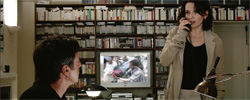
However, Caché also displays a more complex conception of television. Haneke’s most intriguing use of television comes during a family crisis as Georges and Anne frantically search for a suddenly missing Pierrot. During the scene, as a panicked Anne calls another parent, Haneke places his couple at the edges of the screen while he positions a television in the center of his frame. While the couple’s distress increases, the television streams though a series of images from a broadcast of international news. The footage details the ongoing conflicts and hardships of virtually every “brown” culture in the third world, speeding through images of Muslims, Hindus, and Sikhs, and briskly moving from Palestine, to Afghanistan, to Iraq, to Kashmir. Understandably, the couple is too distracted to even note these sensational scenes of the world around them, yet the contrast of their problem to the misery of the foreigners underscores the disparity between nations. The choice of what to concentrate upon is clear for Georges and Anne, but a dilemma is created for the viewer. Do we watch the personal crisis of our fictional couple created in an artificial film, or do we gaze at the authentic footage of real people engaged in a constant catastrophe? On some level we must also ask if it is entirely acceptable for our central couple to completely ignore widespread global adversity for a personal problem. Viewers may also wonder if it is appropriate while watching a film to be diverted by a television screen that our eyes naturally gravitate towards.
What Haneke recognizes is that television is a compelling medium, but it is also an abstraction that allows viewers to maintain a comfortable distance from the subjects within the images being exhibited. That distance allows TV’s images to distract us, but also provides us the option to discard the product just as easily. Hence the distortion allows a TV audience to regard the Third-World populace within the footage as merely images forever trapped in a box that provides passive programming. Whether or not the reality the image is meant to convey remains elusive, Caché ultimately grants the spectator the power of realization. Since he is a TV personality who constantly watches TV and manipulates images both at work (removing a portion of his show during editing because it’s too theoretical) and at home, it’s reasonable to assume that Georges grasps the nature of television. Yet Georges still ignores visual information that does not directly affect his life. Thus, while Haneke often reprimands television for exploiting suffering and desensitizing viewers to violence, Caché also places the responsibility upon the spectator who decides to disregard the images presented to them. Caché may actually be Haneke’s most balanced representation of television’s function to date, since it seems the director is willing to admit the medium has value even while he critiques its use.
Discerning who actually commands the images within Caché and who exactly serves as the spectator to those images becomes an exasperating issue. It is important to distinguish that the film blends various media together and that the images are manipulated by a number of different parties. It is equally important to notice that the film’s audience and the film’s characters often share the same view, but that the film’s audience remains passive and unable to control the action or image. However, with both perspectives fused, the film’s audience should subject themselves to the same scrutiny imposed upon the fictional characters, and consider why exactly we choose to watch a fictionalized film that distorts, and distracts from, the reality of our surrounding world. Furthermore, Haneke appears to invite disapproval of his own decision to fashion an elaborate thriller, since he occasionally allows television, the very medium he constantly berates, to take control of his film.
Caché’s most baffling question is who creates and sends the invasive videotapes to our content couple. Given their content, the videos act as manifestations of the repressed guilt of a disconnected conscience, whether personal or collective. As the target, Georges believes he can sleep off his own misgivings with help from a couple of sleeping pills and a few hours of dream-life. Instead, he ends up trapped in his childhood memories, watching inertly with the audience as we witness the same transgressions occur once more. Anne also carries a noticeable degree of guilt around, though her distress concerns how she is perceived by her son. As Anne’s martial woes mount under the stress of surveillance, the audience is privy to an encounter between Anne and an acquaintance from work that comforts her (notice that Haneke has an onlooker spy on the couple). Amazingly, we later find out Pierrot is distressed by this liaison, though Anne maintains the bond is plutonic. Of course, we have no idea how Pierrot knows about the meeting (could his digital video-camera make him a suspect?), but it feels as though Anne’s misgivings are a result of knowing anyone could be watching her daily activities. Soon it’s as if Caché itself is becoming an embodiment of guilt. By the time the film concludes with a startling and uncertain alliance disposed to the sides of the screen, there doesn’t appear to be an innocent victim among the survivors.
Ultimately, we must recognize that Haneke pulls the strings of Caché and that the film functions as an abrasive experiment more than a straight narrative. Though Caché acts as yet another provocation by Haneke, unlike the typical thriller that exploits the characters’ plight for the audience’s amusement, Haneke’s exercise allows his audience to consider the basic principles and structures of their surrounding civilization. Whereas the French government fabricated a scenario to lure innocent Algerians into a revolting trap, so too has the video-terrorist created puzzling gifts to ensnare Georges into playing his game, just as Haneke has sculpted a video-thriller to entice his audience into examining their own preconceptions. Of course unlike the French government or the concocted aggressor, Haneke’s goals are not self-serving. Instead he has skillfully interlaced the pretense of a thriller into a film that actually seeks to expose the violations we justify and the perspectives we adopt in order to maintain our status within society. With the visual context of the film constantly shifting, Caché isn’t the first film to make the viewer complicit in the events that transpire, but it among the few that have thoroughly analyzed all parties involved in the transmission of images which forms our collective conscience. Since its debut at Cannes, many critics have scoffed at Caché, claiming it to function as just another one of Haneke’s conceited projects designed to amplify his feeling of superiority, with some boldly claiming the film demonstrates that Haneke does not believe in cinema or humanity. Conversely, I believe Caché embraces the possibilities of cinema as an art-form. I’m also certain that Haneke believes in the potential of the human race, especially given Caché’s final frames. It’s just that Haneke simply does not appreciate some of our conduct thus far.
Chiranjit Goswami / © 2005 notcoming.com
Amazing analysis Chiranjit! Was it after only one viewing?? Your decoding of the political role of television (or image) in the film is particularly illuminating.
Thanks for highlighting the unfamiliar nature of threat: a child drawing and a wordless surveillance tape. There is no revendication, no motive, no bribery, no negociation, no pressure. Unlike our usual thriller, the threat is unspoken yet immediately feels intrusive, while it’s all hot air, harmless, offenseless… like a Halloween treat. Actually the police doesn’t bother to investigate, which hints at the overblown hysteria of the couple (or the mistrust of law order…) How is it possible to create a suspense-driven film with such a fake threat? Georges imagines the hypothetical scenario from just a tape devoid of any malevalant indications. So we could suspect all this to come from his head. He reacts impulsively to an inert stimulus. Maybe Haneke subjected his character to hypnosis or a psychoanalytic free association following the exposition to the Rorschach inkblot test. Nothing proves these tapes had any connection Majid, only Georges connects the coincidental dots… that had serious gaps. Afterall the film doesn’t certify the reality of what we see. For instance, the police arrest is eluded, and few on-screen characters could coroborate Georges version. If we refuse to trust a couple of scenes, Georges could easily pass as a mythomaniac, like say Vincent in Cantet’s L’Emploi du Temps. As you point out the fact of being observed has become a threat in itself, which is a syndrome of the individualistic well-off ghettos, fear of stalkers, fear of paparazzi, fear of neighbors, fear of people. Georges seems to understand his money and celebrity is the obvious motive for blackmail, and overlooks any other reasons. I would like to rewatch Resnais’ Muriel, in light of Haneke’s political analysis. There are probably more than just remote similitudes between the two.
Yeah, I’ve actually only been able to watch the film once, way back in September at TIFF. I will pick up the DVD right away, whenever it is released, in order to figure out a few more details. It just seems to be a film that sticks in my mind a great deal. It’s tough to shake – as is Tsai’s The Wayward Cloud.
Just saw this film today, and was hoping that I understood what I saw and didn’t just miss something.
Your essay was incredibly helpful in making me not feel like an idiot.
It was wonderful to see Haneke upset our comfort zones. It was a worthy experiment in trying to upset our apathy towards how we view others by upsetting our apathy towards how we view.
Thanks for this, and I’ll continue to come back to your site often. :)
Wonderful commentary, definitely one of the most complete/reflective pieces I’ve read on the film so far.
I’d be curious to know, however, if I am the only person who sees the videotapes/drawings as purely a mechanism of filmmaking, as if Haneke himself has an omniscient understanding of the characters, and thus plants the videotapes/drawings as a way to draw responses out of the characters, primarily Georges. Although this is considerably from left field, I find this theory to be quite exciting and filled with potential.
Thanks Rahat. I certainly agree with your idea that Haneke might be viewed as the puppet-master within the events that transpire. As I attempted to note in my last paragraph, the viewer must at some point recognize that Haneke does exercise far greater control over the film than any other party. Even though Haneke isn’t a character within the film, the “presence” that causes Georges and his family so much distress is very much a director, and the only person given the director credit (superimposed upon the film itself for us to read) is Haneke.
Chiranjit Fantastic review! I’ve been all over the internet and that is the most complete and rounded appraisal I’ve seen. Thanks! I missed Pierre and Ann being filmed in the cafe. Was this by Pierre’s son, who we had been told earlier was making a film, who then passed it on to Pierrot? Apparantly even Heneke says he doesn’t know who sent the tapes! I think one of the most telling lines comes very early on with Georges saying about the person making the tapes,”why didn’t I see him? It will remain a mystery”.
Thanks Ash. I’m not exactly certain Pierre and Anne are being filmed in the cafe. The conversation appears to be filmed in a similar fashion as every other scene within the film, which of course means it could be either a regular scene within the film or captured on surveillance video. I do find your theory on further collusion between the children very intriguing, since it reaches past just Majid’s son and Pierrot.
The whole movie is a dream, it is the dreamer’s discourse. The dreamer casts and catches the dream.
I should have paid more attention to the closing shot. I thought it was a video of Pierrot, after school, and that the videomaker’s intent was to send that video to the parents to show them that he was still at it, and was now watching their son. It wasn’t until reading some reviews that I realized that there was a meeting between Perrot and Majid’s son? Is that it?
P.S. Your review/analysis was superb.
Thanks Denise. To answer your question, yes, Pierrot and Majid’s son (I don’t believe the film provides him an actual first name) do meet up on the front steps of the school in the final shot. Their inaudible discussion appears to be fairly amicable. I realize this might be considered a spoiler, but I assume most people have watched the film by now, or at least before spending their time to read this review.
Your review of Cache was very thoughful, especially on the role of television. Here’s another theory about who is behind the surveillance. Georges is a television producer, familiar with the equipment, editing and manipulation of images. Could his overwhelming guilt about his treatment of Majid as a boy have impelled him to make the tapes? To set up a situation that would act to force his childhood behavior into the open to humiliate himself? Who else knew the past as well as Georges? Who would know to bring the taping to Majid’s apartment? The only other character who might have such knowledge is Majid’s son. But I was convinced by his denial of having anything to do with the taping when he confronted Georges. I must say my wife and I missed what some respondents refer to as the meeting between the two sons in the final scene. I took that as more videotaping by Georges. The cycle will continue because he can’t escape his guilt just as France can’t escape from its sorry history with the Algerians.
Thank you for your insightful commentary on this film. My daughter and I had been discussing the current American debate on immigration on the way to the theater. Timely for us was Haneke’s admonition to the viewer how small acts of racism and prejudice can have such enormous ramifications to the recipient and the snowball effect these acts have. Thank you for the observation. It seems to me a similar message is portrayed in Crash. Human nature is so incredibly predicatable.
A lingering question: are we to perceive the encounter between the two sons as a hopeful sign that perhaps future generations might transcend these evil legacies?
Thanks, Intrieged and Otis, for the kind words. The theory that Georges may be behind the surveillance tapes did cross my mind while I watched the film. I do believe that Haneke wants us to consider this possibility especially given the fact that he specifically includes a bit about how Georges is very hands-on in the editing of his TV show. Including the moment hints very strongly that Georges has the skills and knowledge to pull this off. However, like a great deal within the film, it remains unresolved. I find it hard to believe that Georges is doing all this deliberately, considering he would be essentially addressing any repressed guilt while making the videos and drawings, and the execution would be rather cruel on the other involved parties, especially considering the toll it takes upon Majid. If this were true, in addressing his past transgressions, Georges would be creating new ones, essentially fashioning a vicious circle. It’s fascinating, but it also requires a rather strange leap of logic on the viewers’ part. It’s possible that he is doing this all unconsciously, but this train of thought on my part makes the film sound like a bad Hollywood psyche-thriller.
As far as how we are supposed to perceive the final meeting between the sons, I’m conflicted about its “meaning”. As I’ve mentioned previously, the meeting does appear to be amicable and the scene itself is rather tranquil, which creates a sense of hope and eases the tension that prevails throughout the film. On the other hand, it’s rather concerning that these two children know one another, given the earlier confrontation between Georges and Majid’s son, and there is a certain tension created by forcing the viewer to frantically scan the frame to find the point of the scene. Though the sons are friendly, if they have conspired against their fathers, or just Georges, their malicious pranks definitely have a steep price. As with so much of Cache, our own predisposition effects how we perceive the image.
I just came from seeing the film and googled “cache movie analysis” for help to wrap my head around what I just saw. Your review is excellent and helpful!
I’ll add one comment about the nature of violence. As an audience member I saw the violence on the news broadcast while Anne is calling their son’s friend’s house. However it didn’t affect me. In contrast, the chicken scene and the throat slitting were very disturbing to me. I wonder if the director creates this to further demonstrate that TV actually insulates us from violence as something that happens “over there.”
When presented with un-glorified “real” violence it is harder to dismiss it as we normally do with violence on TV or even film.
I really enjoyed your piece, Charinjit. The best thing I’ve read on the film so far.
As to the question of how to read the last scene – the meeting of the two sons – I think the answer comes in the third-last (?) scene. In this scene we witness Majid being carted off to an orphanage. This is surely a POV shot – we have seen Georges backed up against the wall of the barn in an earlier flashback scene. So here we have it – Georges is explicitly linked with the static long-shot, the surveillance shot of the film. (Note also that in the early part of the film Georges is seen to emerge walking down the rue de Iris as if he had been standing behind the camera all the while.) The last scene comes after Georges has put himself to bed. Up to this point, sleep has involved Majid-centred nightmares. Could it be that the meeting between Pierrot and Majid’s son is a kind of projected nightmare – a nightmare of a ever-continuing link between the two families (standing for two countries, as you have said)?
With its tapes and its reconstructed memories, ‘Caché’ is clearly homage to David Lynch.
While it doesn’t really effect your theory about the meaning of the “school scene”, I actually remember the sequence of the scenes to be (1) Georges going to bed after having taken sleeping pills, (2) the POV flashback to Majid being taken to the orphanage, (3) Majid’s son meets Pierrot on the school steps, but I haven’t watched the film since September. Whether the final scene is a nightmare or a fantasy is really up to the viewer and what perspective we assume during the final scene. It very well could be a nightmare, but it’s so bland and casual that I find it hard to determine its intensions with any degree of certainty.
I was also wondering about Georges’ implication in the creation of the videotapes for a few reasons. Early in the film, as Georges and Anne are reviewing a tape of their home at night, a car drives by the camera and we clearly see the shadow of the offending camera, which is neither “hidden,” nor a hand-held digital cam, but a full-sized studio camera on a tripod. This type of camera is seen in a subsequent television studio shot. This portion of the tape, with the car driving by, is reviewed twice. At first, I was inclined to be generous and forgive the filmmaker such a production flaw; then I realized it had to be deliberate: another staged element, or clue for the viewer?
Something else to think about is the “staginess” of the final confrontation of Majid and Georges. If this is a scene that is “real” (within the film), why isn’t Georges concerned about the possible whereabouts of the hidden camera? And although Georges would be rather callous and indifferent in the face of such an event, it almost appears that an invisible screen separates Majid from Georges, who remarkable walks away un-spattered by Majid’s blood. And then where does Georges go? To a movie (is it a coincidence that the theater is showing what appears t be family-oriented films along with “Ma Mere”?).
What’s astonishing about this film is that is really makes you ask a lot of questions about so many issues: memory, guilt, suspicion, reality and dreams. And yes, I also too thought of David Lynch’s “Lost Highway” when I first heard the plot of “Cache.”
Perhaps someone noticed the scene in which Georges and Pierrot walk to the car, which is parked on the street in more or less the same location from which the camera was positioned when the first two tapes were made. Georges pulls a piece of paper or a card from his windshield. It does not look like a parking ticket but instead appears to have photographs of people on it. Does anyone know what this is?
I watched the movie a second time and surprised myself by how much I caught myself using the DVD rewind feature, zoom, and so forth, much as Anne and Georges do as they watch the tapes. Perhaps the director knew that viewers would do this and thereby add to the sense of dislocation.
Cache tells a compelling story and asks viewers to think about important issues – most notably that our actions carry sometimes unknown consequences for ourselves and for others, people both close to us and people who are the distant feared “other”. This is an important first step to analysis of sociocultural and interpersonal morality. Haneke has his heart and mind in the right places, and he is asking us to think about some of the most important issues that influence our perceptions of the world around us – betrayal, fear, acknowledgement of wrong vs. covering, threats, comfort, terrorism, oppression, victimization, respect, communication, and voyeurism.
However, this movie would have reached more people with its important messages and powerful symbolism if Haneke had not deliberately chosen to show contempt for the established and already-been-challenged emotional and intellectual processes of movie-watching itself (i.e., the viewer wanting answers). David Lynch will baffle you, but you CAN find answers, you can know who did what to whom. I personally want answers from a mystery, and though I have been able to question that assumption, as Haneke would want me to do, I have decided not to apologize for wanting answers (or for being annoyed by monotony, for that matter). I have concluded that it would not make me deeper or more insightful if I routinely accepted unresolved issues or grating monotony in movies. I am willing to consider my own country’s wrongs against others, my own hidden immaturity, hatred, and racism, my own damaging actions, my own interpersonal immorality and betrayals… I am greatly bothered by these things. I want to look at them (albeit with some flinching) and figure out how to change, but that’s not enough for Haneke. He must push it one step further and alienate me by deliberatly refusing to make his movie watchable – this defiance of artistic media conventions was done in France, by DuChamp and by many French filmmakers when they deconstructed the format and conventions of film. Now that we have questioned why viewers get something out of this, it may be time for directors to move past this form of experimentation and just tell the story, especially one as important as this one, so that it will reach as many people as possible. It is an unfortunate fact that regardless of the message, esoterism in its presentation renders the messenger unpopular (I am struggling with this too in my work). I believe that the filmmakers who will have the most impact on the most viewers will bravely and adeptly challenge the viewer to ask themselves questions related to content as Haneke has done, but the added dimension of defiant cinematic format renders the two challenges distractions of each other – this dichotomy blunted Cache’s power for me, and frankly, wasted time I could have spent thinking about what he actually has to say. I hope someone makes a smartly-done smash hit American remake of it – it will be the only way to get us Americans thinking about our own position in the world and our own horrific betrayal and damage of others.
Sorry for its idaequacies for you, Casauterelle. I found it compelling for every second, as there wasn’t a moment I wasn’t being drawn in, looking for what might have been within the frame, wondering who or what exactly was doing the observing, etc. And I disagree; we Americans (or, at least, not all of us – please don’t talk for me) don’t need to be spoonfed our ideas in typical fashion in order to invite serious thought. I think asking such strenuous efforts invites serious thought even more so, and, at least from my end, makes the movie experience all the more entertaining and satisfying.
Apologies, I wasn’t trying to speak for anyone else – just for myself (dual French and American). I have adopted the common American mentality of wanting to be entertained, or if I am being asked to think, having people just show me directly what they want me to think about. I wish that his messages could have reached more Americans – the ones whose demands dictated the JonBenet Ramsey would be THE top news story here for weeks. That is the majority – it is not right because it is the majority, but it is the predominant mindset in operation here, and the people I wish that Cache could have captured the interest of. Palatability is a very interesting question, and I don’t think it has an easy explanation.
“… Early in the film, as Georges and Anne are reviewing a tape of their home at night, a car drives by the camera and we clearly see the shadow of the offending camera, which is neither “hidden,” nor a hand-held digital cam, but a full-sized studio camera on a tripod … At first, I was inclined to be generous and forgive the filmmaker such a production flaw; then I realized it had to be deliberate: another staged element, or clue for the viewer?” Mark
i also made a similar observation and debated it’s significance and impact on the filmic ‘reality’ … the offending shadow (caused by George’s car headlights as he arrives home) is of the camera filming the scene as it is equipped with mattebox, follow focus, tripod etc (not really the kind of camera used for ‘spying’) … ordinarily if a shadow like this was noticed by the viewer it would break the reality of the film momentarily or altogether because it is obviously not meant to be within the reality of the story …
however because it is a Haneke film we tend to automatically read into things (because everything is there for a reason even if that is that it is ultimately meaningless) … so we try to rationalise it … why would Haneke leave such a significant ‘mistake’ in his film?
the theory i had when i first watched the film was that it is Haneke himself who is sending the tapes in order to force Georges to confront his ‘guilty’ past … and not one of the characters within the film (that would be to conventional) … so if you add to this the shadow of Haneke’s camera within the film it makes even more sense that he is the ‘real’ voyeur and manipulator outside as well as inside the film …
this is backed up with the fact that the ‘taped’ image is the same as the filmed image we are watching (shot with the same camera) and not a handycam (of lesser image quality) … the main reason is so Haneke’s simple yet clever manipulation of ‘reality’ could work … his rewinding and replaying what we have just seen and assumed was ‘a reality’, which had to be seamless … so ultimately there is no ‘hidden’ camera other than that of Haneke’s … which he gives us a glimpse of …
however, one fact that complicates this theory is the fact that Haneke’s camera shadow is captured on the tape and thus viewed by the characters within the film … so they should be aware of Haneke’s camera (or at least a camera) … why did they not see it when we can?
… ultimately this doesn’t have a significant effect on the dramatic aspects of the film … and obviously has gone unnoticed by most … it is however an interesting element that adds another layer to the film, whether Haneke intended it to be there or not.
“Cache” is an incredible film, being smart, dark, adult, cinematic, mysterious and all such things. But upon consideration, my prior conclusions about Hanake’s “provocations” remained only slightly altered. I felt he made incredible films despite their stunning shows of – I guess I’ll use a strong term as it seems appropriate – loathing for the audience. “Funny Games” wishes to condemn the watcher for watching, when really what it presents is a brilliantly gruelling onslaught of terror (throw it in the bag with Hooper’s “The Texas Chainsaw Massacre” and “Wolf Creek”) about our fears of invasion and violation. “Cache” is far more sophisticated in is misanthropic distrust of the modern audience, but it’s also a film of great self-loathing. Who else it going to sit around a dinner table, surrounded by comfort and acclaimed literature, discussing the meaning of “cinema” but Hanake and friends? It is self-deluding that with “Funny Games” and “Benny’s Video” that he condemn what he sees to be young homicidally inclined voyeurs and horror fans when he himself has utilised horror shocks and motifs so brilliantly. Never have I seen such a physical and vocal, unified audience reaction as with THAT razor-wielding scene in “Cache”. How thin the line between the headless chicken of “Cache” and the turtle killing of “Cannibal Holocaust”: arguably the former has proper symbolic properties, but they are both used for great bloody shock value. I am not condemning Hanake for these tricks – I like them; I think they fill the drama with menace and leave the viewer unprepared for what might come next. But he is a man that protests too much sometimes, me thinks.
(spoilers, of course)
Luckily, “Cache” is laced with consistent cinematic intelligence and sophistication that undermines Hanake’s own somewhat conservative inclinations. It doesn’t seem surprising to me that he would post the blame on the children. Children, in that particularly modern paradox, are both the innocent bounty of modern life, and its alien, unfathomable harbringers of horror and violence.
I read the final school shot as a great hint that the sons had collaborated: this checks all the boxes. It gives grounds for Pierrot’s teenaged indifference to his parents. Majid’s son found Pierrot, told him about their fathers’ history, and they decide to provoke an admission of guilt from Georges, and therein they suppose a subsequent apology. When the plan backfires, the film conjures a terrible tragedy. In trying to save their fathers, they have destroyed them both. When I realised that underneath the drama of Georges’ search for perpetrator and past, there was a parrallel tale of tragedy, it only made my jaw drop further and my respect for the storytelling deepen.
For this reason, for this prefered interpretation of who sent the pictures and so on, I am unwilling to accept the idea wisely expressed here – and in Film Comment, if I remember rightly – that Hanake himself is responsible for the videos and pictures. (And while we are at it: how quaint of Hanake to rely upon videos in the era of DVD) How tediously self-reflexive of him, and how they can all rush to their dinner parties and film shows to debate. (Similarly, I simply snorted at the “rewind” scene in “Funny Games”) It’s been suggested that Georges sent himself the provocations to force himself to confront his past – but he takes a long time to go about it, and surely the man is too vain and delusional? is that not the point? The idea that the final school shot is further surveillance to be sent to Georges … well, I was so taken with my interepretation of it that I did not think of this. It’s possible, and opens up other questions, the answer to which I can only believe to be that Hanake is responsible. The other interpretation of the ending is that the boys weren’t really responsible, but that the tragedy formed an alliance between them that speaks of a hopeful future. Stubbornly, maybe, I cling to my first interpretation because it ticks the boxes, offers a secondary coherent narrative we never see, and it fits an agenda Hanake has dwelt on continuously: don’t trust the kids. But despite this, as Chiranjit has wonderfully written, “Cache” is surely Hanake’s most balanced work and generalisations are not easily justified.
So I find myself in a love-hate response to Hanake. “Cache” is a brilliant drama with horror trimmings (yes, even those wonderfully evocative ‘children’s drawings’). I love it, although Hanake might condemn me for it.
And thank you to everyone here who has posted such an enlightening wealth of responses – I learned much!
Now to go do something more worthwhile, hehe.
In May 2007, several months after this article was published – even several months after the last comment – I saw this film for the first time, and was very grateful to read such interesting commentary from the author and the commenters. Thanks all.
First of all I would just like to compliment and thank Chiranjit and all of the reviewers for exploring this film so thoroughly and giving me a sense of enlightenment. I must say I am a little hesitant to the theory that Georges himself created the videotapes, though a few people have pointed out interesting evidence that he would be quite capable of doing so. The idea of Hanake playing with the viewers’ minds and sending the films to Georges also seems a little far-fetched to me, but then again, this is the first of his films I have seen. I am most in agreement with the idea that Pierrot may have set up the whole thing, especially after dissecting the last scene in the film where he has a meeting with Majid’s son on the school steps. As well, there were two scenes which I felt were highly significant which it seems noone has yet discussed (though I may be mistaken). Near the beginning of the film there are two extremely short segments (only a few seconds long) that show Pierrot (I believe) in the bathroom with blood dripping down his face. Though it’s possible that these are further dreams of Georges that give insight into his traumatic past and repressed guilt, the fact that they are not interposed directly after scenes of Georges going to sleep (like his other dreams) indicate to me that they could perhaps have different meaning. I had the idea that they could be symbolic indicators of Pierrot’s involvement in the videotapes — he has the blood dripping down his chin, the guilt, that show there is maybe more to him than would seem and he is another party that is aware of Georges’ loathsome past. What are your ideas?
I knew that there were clues in the credit scene. I focused on what looks like letters on the roof line of the car in the foreground. Has anyone else tried to decipher this as a clue?
in regards to the final shot and the meeting between majid’s son and george’s son pierrot, it seems clear from the body language and the way that majid’s son approaches pierrot that he is meeting him for the first time and is explaining himself to pierrot … people seem too eager to read something ulterior into the meeting and want a tidy resolution and answer to the film – to unmask the sender of the tapes (this is from being overexposed to conventional storytelling which demands this) … but this is not haneke’s style he knows that there are no clean and tidy resolutions in life so why should there be in cinema?
as for pierrot’s behavior – well he is a confused teenager and is merely acting out – he knows his parents are unhappy and suspects his mother is seeing someone else … this does not mean that he is making the cassettes in league with majid’s son – he is angry with his mother not his father so this logic does not make sense …
as for majid’s son – he is bitter at george’s indifference for what he did to his father as a child and what happened to majid as a result of george’s selfish act … however this does not equate to him making the tapes, both from a technical point of view (having the means of creating the tapes) and from what is revealed psychologically by him as a character … as i suggested before it is ultimately haneke that is making the tapes as a way of confronting george about his guilty past (conscience) and this leads him to instantly suspect majid whom he knows he wronged as a child …
the final shot is a subtle attempt at some kind of recognition and awareness between the two siblings of the unspoken and tragic history that exists between their families and ultimately france and algeria … i think if anything it shows that majid’s son no longer holds a grudge but is instead trying to move ahead
the beauty of the film is that it is completely open to individual interpretations (…)
Sorry but if you want a film to be told as a narritive story the the characters have to act as if they were real. And they didnt . The motivies for so many actions were strange and contrived. As such Cache is exploiting its audience by mixing film genres and the viewers expectations.
If the direstor had a message he should have spelt it out a bit more……..its easy to creative unrealistic dialog and plot ..and create a mystery.
Its a wind up ! And it seems a lot of people here fell for it . Im sure Haneke would enjoy the initial detailed analysis here …and would be as amusingly perplexed as I was :)
Its one of those french films where you scratch your head at the end of it and wish you had gone to the pub
barry with as much
I actually don’t believe Haneke wants us to view his film as just a narrative story. I’m also quite comfortable with Haneke exploiting his audience, using his characters as tools within his films, and also with his refusal to clearly spell out any message.
The film Georges went to see after the suicide was the ‘two brothers’.
Which seems to me,at any rate,seems to have been the entire meaning of the film in all respects. France & Algeria,Majid and George and Perriot and Majid’s son.
Brilliant review btw Chiranjit. I watched the movie on bluray last night and can’t stop thinking about it which is how I ended up on this site.
Thanks.
I don’t understand why loathing the spectator, which Haneke clearly does, is either bad or a reason not to take an artist seriously. What makes the spectator exempt from loathing? Isn’t the spectator an important component of a film? It seems to me that fear of the spectator, love of the spectator, loathing of the spectator, is a perfectly reasonable subject for any work of art. Not every filmmaker has to be a humanist, and who would want such a thing anyway? An argument could be made that Haneke’s films, at their core, are about the act of watching, what it does to the spectator, how it affects the spectators relation to life that is not mediated. Is he a moralist? Sure. But in Haneke’s case, people seem to take offense at his message. I don’t. I am offended by filmmakers like Steven Spielberg, who wrap their exploitation in the guise of lessons learned.
And Haneke sent the tapes. The tapes and the movie we are watching are shot by the same person. This seems pretty obvious to me, especially when you take into account that Haneke, several times during the movie, blurs the lines between the film you are watching (a film by Michael Haneke) and the tapes you are shown within the film. There is no difference between the two.
Directed by
Michael Haneke
Source
Sony Pictures Classics 35mm print
Features: The 30th Toronto International Film Festival
Reviews: Benny’s Video
Reviews: Funny Games
Reviews: The Seventh Continent
Reviews: Time of the Wolf
Posted on
07 October 2005
Read
6308 times
Comments
31
HarryTuttle
21 October 2005
7:38 PM
Website