


Reviews
Ray C. Smallwood
USA, 1921
Credits
Review by Jack Gardner
Posted on 24 April 2006
Source Warner Brothers DVD
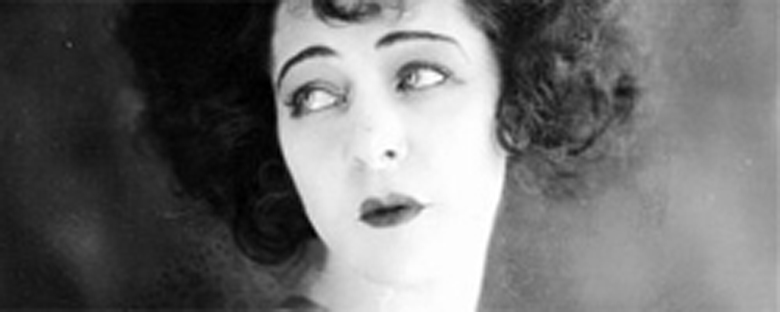
The often-told tale of the consumptive courtesan Marguerite Gautier, and the young man, Armand Duval, who makes her fall truly in love, is one I typically associate with Greta Garbo. The 1936 Garbo film is a classic and a beautiful movie, but this is a role many actresses long to tackle—Garbo’s film was at least the 11th cinematic version of the Dumas story. It had been previously filmed by Sarah Bernhardt, Clara Kimball Young, Norma Talmadge, Pola Negri, Theda Bara, and in the version reviewed here, the 9th, by the Russian stage legend Alla Nazimova.
Nazimova was established as a great stage star in Russia when she immigrated to the United States in 1905. She was an early fan of motion pictures, and had publicly announced her desire to film movies as early as 1912—an unusual ambition for a stage star of her day, and one she would fulfill in 1916, when movie producers first cast her in the film War Brides. Camille, her only picture in 1921, was her 11th film, and she was becoming a well-known screen personality thereafter. Her career would continue both on stage and screen until her death in 1945 at age 66, but by 1923 her popularity in Hollywood started to diminish as she became more and more eccentric in both her public image and private life. It was during this time that the public began to move away from the exotic screen sirens in favor of the Girl-Next-Door type personified by actresses like Clara Bow and Joan Crawford, and “Vamps” such as Nazimova and Theda Bara were considered passé.
Camille also features a young Rudolph Valentino, fresh from his success in The Four Horsemen of the Apocalypse. (This would be his last Metro picture before returning to Famous Players Lasky/Paramount to make The Sheik.) He gives a strong performance in this film; you get a glimpse of the star he was very soon to become. The sets and costumes were designed by Natacha Rambova and it was during this production that her romance with Valentino began. They would be married the next year.
This version of Camille is set in “Modern Times” circa 1921. The picture opens on a fantastic staircase outside a theater, and then moves to Marguerite’s superb art deco home. Everything is full of curves and circles to represent camellias. The acting in the picture is also superb. Even though there’s lots of stunning art deco scenery to chew, the actors resist overacting and both Nazimova and Valentino inhabit their parts with subtlety—Nazimova is both playful and fragile as the ill-fated Marguerite, and Valentino shy and romantic as Armand.
The edition available on Warner DVD is included as a supplement to the 1936 Garbo version of the Dumas novel. Comparing the two versions of this film is almost impossible as they are completely different interpretations of the same story. Where Garbo’s Marguerite is laces and crinolines and 19th Century, Nazimova brings her Marguerite to life in the midst of the jazz age, the Charleston and the Tango.
We don’t do comments anymore, but you may contact us here or find us on Twitter or Facebook.