

To mind the single most frightening image in film is the baby in David Lynch’s Eraserhead. The thing, grotesquely deformed, bears no direct human characteristic aside from its persistent cry. Its head, roughly the size of a fist, sports two spotty eyes on either side. Its limbless body contained in a mummified wrap.
This “child” is the progeny of reluctant parents Henry and Mary. The two share not one exchange without displaying some obvious fear of what they have produced. This baby is the horrid manifestation of the fear of parental responsibility; it is embarrassingly hideous and difficult to care for.
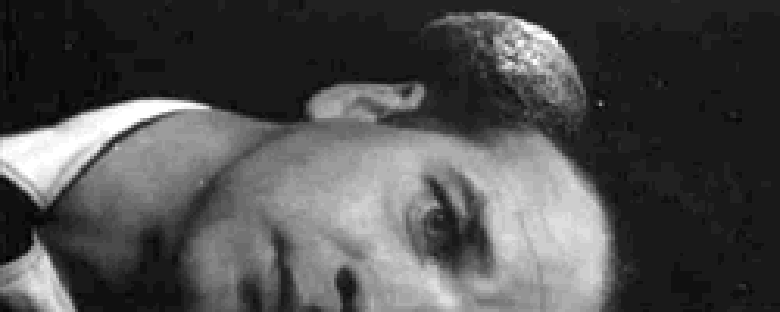
The title Eraserhead is a literal reference to a scene late in the film in which Henry’s head falls off. It is surrounded by a pool of blood and it falls through an unseen hole. It lands on a day-lit street, a boy picks it up, sells it to a clerk at a factory that fashions and attaches erasers onto pencils. Henry’s head is drilled into, the offshoot is made into an eraser, hence, eraser-head. Attempting to reason this sort of logic is somewhat futile. In this dark nightmare literalism is as unlikely as a light that doesn’t flicker.
Lynch’s work, (particularly this, Lost Highway and Mulholland Drive) is often described as dream-like or nightmarish, being that his films incorporate a logic best understood in the context of a dream. In truth there is no other way, really, in the vein of traditional criticism to describe it. Eraserhead is a film that seems to require interpretation. Answers, however, are so distant that one wonders if they are even intended.
Of the three cited films Eraserhead is the one that sports a noticeable narrative closure. Though the film’s narrative is evident, the progression from the film’s opening to ending is heedlessly meandering in its direction. Unlike Lynch’s later efforts, the metaphoric quality in Eraserhead is not only implied but apparent.
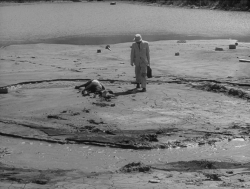
Consider the opening: Henry’s head is seen superimposed over a spherical rock. Inside the stone is a man staring out a window. The man pulls a lever; a worm is dispelled from inside Henry. This bombardment of unswallowable imagery occurs in the film’s first minutes. One may note that no portion of the film occurs in the rubric of filmic convention, nor, for that matter, does it adhere to any discernable formula. And thus this persistent barrage of stark sounds and images become progressively weird.
Ultimately, in a decade known for producing the most sexually subversive and visually unique films in history, Eraserhead is distinguished as one of its most idiosyncratic entries. Eraserhead rivals any work of surrealism.
The film was made with a grant from the American Film Institute, along with donations from family and friends. One famous bit of trivia is that Lynch got a paper route close to the end of filming to secure his budget. Eraserhead was shot deliberately over the course of three years (the film is similarly paced). This level of exacting direction is evident in every minute of the film. When Henry waits in an elevator, it takes exactly thirteen seconds for the device to raise. Likewise, Henry’s apartment number is 26 (thirteen doubled); Mary’s apartment is number 2416 (2+4+1+6=13). Again, the meaning of these symbols is unknown, yet their noticeable frequency suggests that they “mean” something.
Although Eraserhead was legitimately released in 1977, it has come to be known as a perennial midnight movie, airing in sporadic late-night screenings across the globe.
Despite its defiance of interpretation, one motif in Eraserhead remains largely curious. In Henry’s dark apartment is a radiator. Henry will look at it, scratchy, 30s jazz will play, and the face of a woman will appear. She is dressed in all white, and has very large cheeks. This action occurs repeatedly.
Henry eventually finds way to enter the radiator. Once inside he is on a stage, with the woman (credited, simply, as “the lady in the radiator”). She is kind and inviting, yet when Henry attempts to embrace her he is shocked (an action mimicked visually by a flash of white). A theory (not my own) underlines this image, and forces an interpretation of the film.
This lady in the radiator is death. She intrigues Henry because she is a form of escape from his existence. To further secure this claim is her soothing anthem “in heaven everything is fine.”
The film is often described to occur in a post-apocalyptic setting (which is, in effect, a criticism paired with the film’s theme of isolation). The abundant 30s jazz counterbalances Henry’s contemporary parental paranoia. Exposing this dialectic aids not in interpreting the film; it rather serves to illustrate the level of analysis that may be used to do so. Answers in Eraserhead may be entirely obscured, though attempting to solve this or any logic in Lynch’s canon, for that matter, is nearly custom in viewing his films.
Rumsey Taylor / © 2004 notcoming.com
I never thought the lady in the radiator represented death, although it is an intriguing interpretation. I see the film’s message as being partly existential. Eraserhead is paralyzed by inaction. In the end he murders his own baby and this is his first act of intentionality. For this he gets to join the lady in the radiator, who in this interpretation represents freedom of action.
Eraserhead must also noted for its sound design. It elevates the movie to truly nightmarish heights. Who could forget those shrieks and moans ? Even in its quiet moments, there’s a palpable dread due to the background factory hum.
This film seems to be about urban decay as well as other things. I think this because he and his wife live inside a machine, the droning sounds in the entirety of the film are ones of factoiries. I think maybe one of his comments is on man and machine and the growing connectedness.
I agree that sound plays a vital role in this film. After viewing it for the first time recently, I found myself thinking more about the music and the ambient noises than the narrative. The visual surroundings are oddly memorable, to be sure, but to me, the aural experience of Eraserhead enhances Henry’s nightmare world more memorably.
Eraserhead is an exercise in pure cinema. It’s an object of near pure experience. It is the closest thing to watching someone else’s dream. Like a dream, it is hard to interpret. The difficulty is magnified by the fact that the dream is not our own and the man with the nearest thing to a secret decoder ring, Lynch, evidently isn’t interested in helping us.
When somenone develops a reliable method of dream interpretation, Eraserhead will be understood. (And no, Freud didn’t get it right).
Yes, and I particularly like Trent Reznor’s work in Nine Inch Nails, so finding out he’d done music for David Lynch’s “Lost Highway”, I headed out to get it. They didn’t have it so I got “Eraserhead” instead. And man, that neighbour of his is HOT! There’s just something about her. HOT DAMN! I smell shit.
I agree with most of the other interpretations here. I’d like to offer a few more:
I think the term “Eraserhead” is a reference to nothingness. When Henry’s head pops off, it is replaced by his baby’s. I think this means that Henry has died, or is dying, and has passed his sense of life onto the child. The child later is represented as the boy running on the street, who steals Henry’s head (once again, another representation of inheritance) as the feeble old man can only watch in horror. The old man is obviously Henry. The kid then cashes the head in for money, the head is “erased” back into nothing when it becomes an eraser, and the kid’s initiation process into life is completed. Also, it’s worth noting that the erasers are manafactured in mass quantities that are indistinguishable from each other, an obvious reference to the pre-mechanization of life. Henry’s life is also represented as mere pencil shavings to be cast aside into the infinite.
Furthermore, I think the deformed child may be simply a symbol for the monstrous death trap of life and all it’s suffering. When he kills it, he is killing himself, as seen when the huge version of the baby consumes him. After this he is free, off to join the Lady in the Radiator. The hideous mechanic, who is probably God (a god confused about his own life, and the life of his creation; it’s suffering is our suffering), turns the gears of life once more. For that matter, the film’s beginning sequence is probably Henry being born. If you look at it from this viewpoint, the film is basically about the cycle of life and death, and the mysteries surrounding it. Since it is often represented as grotesque—-espescially with the parasitic appearance of what I think of as a sort of ‘birth-worm’ seen throughout—-we can surmise that the film is sort of misanthropic (or possibly nihilstic) viewing of this cycle.
In any case, this is probably not a new interpretation. It’s just what I got from the film.
“Consider the opening: Henry’s head is seen superimposed over a spherical rock. Inside the stone is a man staring out a window. The man pulls a lever; a worm is dispelled from inside Henry.”
The man is referred to The Man in the Planet, which could imply God, or simply the mechanical, unthinking but ennervating biological force which forms the genetic materials of life. (ie: the male genitalia?). The worm most obviously appears to be a sperm, and therefore the genetic contribution of Henry to his “baby.” When the lady in the radiator crushes these same worm/sperm’s underfoot, the message seems bleak for Henry. Or maybe it’s a wish upon the part of Henry to erase his own bleak existence and hence be free of the futile exercise of raising his unfortunate offspring. This offspring itself- likely to have a bleak existence only to end up resulting in the same tragicomic end as that of Henry. (ie: to be “erased” and scattered to the wind, as eraser shavings…an interesting take on the funereal intonation “ashes to ashes…”) That he ends the cycle by “ending” the baby seems a fatalistic view of the cyclical aspects of nature and life.
I agree with the interpretations about the deformed baby being a manifestation of the fact that it’s unwanted and the neighbor being Henry’s first step toward freedom. Based on this, I interpret the whole head falling off/eraser making scene as his own guilt about what has occurred as well as the new fear he has of the consequences from his wife’s parents. I wouldn’t be surprised if Lynch was at one point faced with the decision of abortion and dreamt this. I say this because these are the emotions that I had to deal with myself.
I agree. I don’t know how much Lynch intends to tell us about himself or his personal life and experiences in Eraserhead, except that something (whatever that is) is there, it’s a persistent subconscious undercurrent that drives the action in Eraserhead. Things happen, but what is important and what serves more to enhance the tone of the film is niether more or less important than the other. Images are images, characters are characters. They can be casually dismissed or taken symbolically, implying a greater meaning in Henry’s dark world. I also see Eraserhead as a culmination of many of his early visual stylings (see “The Short Films of D.L.” DVD), and it certainly is if you’ve seen shorts such as “The Grandmother”, for one. But aside from any interpretation and deeper meanings, I see Eraserhead exactly for what it is, “a dream of dark and troubling things”, composed of images both comical, terrifying, unexplained, meaningful, meaningless, happy, and hopeless, just like in an actual dream. Each of Lynch’s outings is of merit, from Elephant Man to Blue Velvet, Mulholland Dr, and others, but Eraserhead is by far his greatest achievement. It’s the dawn of an artistic and visual genius that has gone underappreciated by mainstream masses, but greatly admired by those who carry an appreciation for cutting-edge film.
The main thing that people seem to pick up on when interpretting this film is something that i fully agree with. This is a film about anxieties about growing up and fatherhood, being manifested into a horrible nightmare.
But what I really thought this was about (one aspect of the above interpretation), and not many people seem to comment on, is this. It is a film about self loathing. It is about feeling something is wrong with you, hating yourself, and the fear of passing on your crap DNA along with all your inadequacies and shortcomings, along to your child.
Don’t forget the chickens. “They’re new!”
My take on the film, which I use in my thesis, is that the whole story is actually a metaphor, in that each character is a metaphor, or more to the point, each is a metaphorical part of a larger metaphor. Henry, the Eraserhead, is the baffled train of thought that winds through the picture, trying to erase the various distressing signs of his world’s decay; his wife the voice of reason that aborts after the baby shows up and the baby is in fact a brain tumor that is destroying the function of the world, i.e. whoever’s mind (perhaps Henry’s). The sounds heard throughout are the echoes in one’s head. The eraserhead pencil thing is actually the one step out explaination that is the key to it all. The Lady in the Radiator is Death… and when he recedes to there, he dies, after all that has gone on. Its not a clean explanation totally, but such is the way of the logic of illogical things.
I just watched Eraserhead for the first time and found myself wondering throughout about who decides what art is. I am an artist and am often intrigued by how art is defined. I found the movie to be quite captivating but I can’t say why. It was ingeniously visual and at the same time hard to watch. I agree with all the above-mentioned implied interpretations but again found myself asking “why?”.
This was the film I saw at thirteen that I credit with opening my mind to cinema and art and so on. Certainly, it was the first time I ever considered that film didn’t necessarily want to be “entertaining”, or that one could look and feel exactly like my nightmares. (I blogged all about growing up watching David Lynch at my blog.) I have read on a number of other boards about Eraserhead, and it still seems to be a definitive litmus test.
I also have to agree with Andrew above, that this is also a film about self-loathing and that this is not a point often mentioned. I have the soundtrack on cd, and it is just wonderful nightmare ambience.
In addition to what has been stated previously, I thought it was worth noting that many of Lynch’s formative years were spent in Philadelphia. The post-apocolyptic land in which Henry lives was based in no small part on Lynch’s own experience living in an urban area full of closed down factories and an abandoned industrial/mining economy. Though painted with a hyperbolic brush, references to Philadelphia also appear in the Twin Peaks series/FWWM. What follows are a few Lynch quotes re Philadelphia which support my claim: “Yes, [Philadelphia is] horrible, but in a very interesting way. There were places there that had been allowed to decay, where there was so much fear and crime that just for a moment there was an opening to another world. It was fear, but it was so strong, and so magical, like a magnet, that your imagination was always sparking in Philadelphia…I just have to think of Philadelphia now, and I get ideas, I hear the wind, and I’m off into the darkness somewhere.” “…when I was there it was a very sick, twisted, violent, fear-ridden, decadent, decaying place.” “Philadelphia, more than any filmmaker, influenced me. It’s the sickest, most corrupt, decaying, fear-ridden city imaginable. I was very poor and living in bad areas. I felt like I was constantly in danger. But it was so fantastic at the same time.” “I had my first thrilling thought in Philadelphia.” -MJ
The inaction interpretation is quite interesting. That’s fun to roll over. Would that make the man in the planet fate? That the levers are the circumstances that corner Henry into reaction? That’s interesting. The escape interpretation is very intriguing as well. What if the planet represents himself? and the man in the planet is his own mind? That would make the worms the problems and responsibilities that he has to deal with (the worms are on the surface, when you see the worm escape from the cupboard it only scrapes the surface), and that within him there is heaven (the lady in the radiator) but when he tries to find that by being with the lady he is reminded of is responsibilities (of his tree, and of the child) and when he kills the child, the way to that place within himself is opened (the hole in the planet) and there he finds the lady, and peace. When the lady across the hall sees him, he sees both his life (the planet) and his responsibility (the child) and both disgust her.
The eraser scene shows more the decay of his world, and that the eraser dust surrounds him shows that the mind (the planet) is surrounded by this decay, and that from his mind this dust is created shows that the state of his environment is directly attributed to his frame of mind (and his actions). That scene directly follows the lady in the radiator scene and the physical manifestation of what holds him back from that peaceful state (each killing him, as the baby destroys his body or social being and the his possessions (represented by the tree) which holds his blood), when his head is found and becomes the eraser, it shows that his mind creates his own situations (another example is that when the man in the planet (his mind) pulls the lever (acts for him) he produces a worm from himself which represents a situation (or perhaps an action) and that is what starts the film and puts him in his position). When the baby dies, so does his house, in fits of sparks, and he escapes.
In summary, I believe that the Planet is himself, the man in the planet is his mind, and from his mind these problems arrive, and that to be rid of these scenarios is the only way to find peace. Possible?
I just want to say that this film changed my life.It completly changed the way i think about art and film and just the world in general.Its disturbing and beautiful at the same time. i agree with what other people said about it being the closest thing to watching a dream. If anyone hasnt seen this I higly reccomend it, along with all the other Lynch films.
First of all let me say that I’ve watched the film quite a number of times simply because of its striking visuals and it is one of the most surreal films I’ve ever seen. In my view, the film represents Henry’s(and also the director’s) fears and anxieties about the different stages in life and not really any particular beliefs. One recurring theme which I thought was prominent in the film was the hopelessness that we all share. Why keep on living and why keep humanity alive by reproducing? Hence the vain attempt to murder the baby(the baby’s head appears in place of Henry’s body in the end), suicide by Henry. All the scenes give a heightened sense of reality which we sometimes feel in dreams for example when Henry cuts the chickens everybody is looking at him and his anxiousness is artistically represented as the bleeding chickens. I can totally relate to the uncanny behavious of almost everyone in the film, one of the most haunting visions or experience during a nightmare can be when people simply don’t behave the way they are expected to, although they may turn out to be harmless in the eventually. The lady in the radiator is most probably death. She lures Henry by singing “in heaven everything is fine”, but there is an abrupt reaction when he tries to embrace her. Suicide can be tempting sometimes. Finally, eraserhead refers to the continuity of the human existence, however, small and insignificant it may seem, it is persistent and not even humanity itself can cause it to cease. Again, the emergence of the baby’s head from Henry’s body proves that although we may never seem to understand our individual purposes in this world, but humanity as a whole has some purpose. Survival is the most basic.
I feel that the end of the film, with the baby replacing Henry’s head in the doorway is simply showing what the woman next door sees, instead of Henry’s face.
In the scene inside the radiator, when Henry’s head pops off and the baby’s head pokes out, that seems to me to simply be symbolism for Henry’s overwhelming guilt causing him to kill himself, and fall into the underworld.
Of course the subsequent scenes with his head being cracked open and being used as product don’t correspond or add up to a logical whole, but do any dreams?
to me the baby represents Henry’s guilt. Henry is afraid of his lust and confused about his feelings for his partner which created the baby. The mother can not take tending to the baby (Henrys guilt) and bolts leaving Henry alone realizing a self fullfiling prophecy. When Henry is sleeping with his neighbor he ignores the baby and tries to keep her from paying any attention to it. Henry is very insecure and guilt ridden and when he sees his neighbor as another man his head turns into the baby because that is how he views himself in self doubting moments and assumes others see it that way. The radiator and chimpmunk girl are death when he stares off at the radiator he is contemplating suicide “in heaven everything is fine” he views this as his way out. when his head gets turned into an eraser it is Henry’s wish that his existence and presence is erased from the world. the guy at the begining and end I think is a god not a controlling god but a creator and a spectator that cannot stop any of the horrible things that happen or are felt. when henry cuts open the baby and stabs the heart he is killing himself and giving himself up to the death chimpunk lady of the radiator “in heaven everything is fine
i think the fact that, even decades later, lynch will not reveal the metaphorical representations in this film points to a few things. the fact that it is pretentious and tedious and the only thing deep about it would be the critiques offered by individuals. people like to pretend to be deep. while i was watching this movie, there were scenes in which i debated with myself over turning off the tube. i mean he it was his first film in art school, come on. anyone who has been around art school people know that they love to be mysteriously pretentious and when you ask them explicitly about a subject they tend to go through some conversational judo. i actually did enjoy the movie despite certain scenes where i laughed out loud at the forced imagery. if it represents anything, i would say it is a surreal representation of reality. thats it. the dirt in various places clued me into this because they reminded me of doing acid. you just kind of look at what is always around you but you have inner questions like “was there always so much dust on my radiator?” all the scenes in the film seem abstracted from everyday life but wacked out on acid or a mental disorder. if you want to find a deeper meaning, i suggest going to an actual eraser factory on acid and questioning everyones intentions, including your own, throughout every action they take. aka a pointless endeavor. still, the movie was absolutely phenomenal at creating visceral responses. cutting and stabbing the baby, TENSE dinner with the parents of girlfriend, backed up against a wall by the mother in law, i mean wow, he looked like how i felt in very psychically vulnerable situations.
Not that this will influence your opinion, claysmith, but it’s worth pointing out that Eraserhead was neither Lynch’s first film, nor was it made in art school. Lynch had already attended PAFA, where he made several short films, including the excellent and monumentally disturbing The Grandmother. That film was financed by the AFI Conservatory where Lynch then studied for an MFA and began work on Eraserhead, which took him six years (and a paper route) to complete. Not exactly the art-school wafflings of a cloistered trust-fund kid.
Now that that’s out of the way, I don’t think there’s anything particularly revealing – positively or negatively – about Lynch’s unwillingness to discuss the film’s metaphors. The whole discussion of what is deep versus what is simply pretentious is completely irrelevant (and, to me, tedious), as a consistent system of metaphors or symbols does not itself automatically generate “depth,” whatever that is.
Actually, Eraserhead is far from my favorite Lynch film precisely because I think its metaphors, such as they are, are fairly easy to read, at least in comparison to his later work. By contrast, films like Mulholland Dr. and Inland Empire strike me as very open to divergent interpretations or even resist interpretation entirely, in spite of many viewers’ rather deadening attempts to find meaning and coherence in them.
In that way, I partly agree with you that Lynch’s films seem to work best on a visceral level. But they do so, I think, by deliberately playing with (and often against) the kinds of intellectual, interpretive responses that one is inclined to have as a spectator.
I just watched this film for the first time last night and my initial interpretive reaction was similar to others. However, I didn’t see the Lady in the Radiator as death, but entertainment, or the entertainment industry. She is, after all, on a stage. Henry’s ever increasing interaction may represent the need for further escapism from a harsh and bleak existence. I base this on the guttural reaction I had to the haunting song she sings. I was completely overwhelmed with an electric emotion when it came on. It is almost as if Lynch is offering it as a reward for sitting through the first hour of the hyper-realistic, industrialized mud-luscious muck we endure. I immediately went back and transposed it to guitar after the film ended. I wanted the song for myself. A couple of questions still endure.
1) Why did Henry put his left sock on the radiator to dry when it was his right foot that stepped in the puddle?
2) Why no 13 second delay the second time he took the lift?
3) Why the variation of lyrics? ‘i’ve got mine.’ ‘you’ve got mine.’
4) And why the over the top, appeasing and childlike countenance of the Lady in the Radiator despite her disfigurement?
Maybe instead of Death she represents passivity, lethargy, and the false promise of hollow and thoughtless entertainment. Any other opinions would be GREATLY appreciated.
I have come up with an interesting interpretation of Eraserhead. Don’t know if someone else has come up with it before. Please let me know as I’d be interested in reading a similar interpretation:
I believe the bleeding baby chicken is a foreshadowing of Henry stabbing the baby at the end of the movie. This part is somewhat obvious: Baby chicken representing the “Baby”. Note that he stabs the chicken with a fork just as he stabs the baby with the scissors. He has exactly the same shocked look on his face after each.
The deformed baby actually resembles a chicken in some ways. If you’ll notice the only body parts the baby seems to have are those that are normally removed from a chicken before serving: The head, neck and internal organs. Grotesquely I believe the baby is the other half of the chicken!
I generally agree that a good interpretation of the movie has it being about the fears of being a father (and a husband), and of inadequacy and self-loathing in general. The baby represents that anxiety of responsibility, while the Lady In The Radiator is a flight of fancy—an imagined place to get away. I also agree that getting away could easily represent death, which is the ultimate escape, especially from a world that you feel is crushing you. And Henry’s final step is to commit suicide and finally meet the Lady, in Heaven, where everything is fine (he hopes).
To respond to buckj54, the change in the lyric is quite clever. The first time she sings “You got your good things, and I’ve got mine,” which is a conventional view of ownership and happiness in the real, physical world. But the second time she sings “You got your good thing and you’ve got mine.” This is a more Heaven-centered view, where there is no time or space as we understand them, and everyone’s part of a cosmic consciousness, thus you not only have your own good things, you’ve got everyone’s good things.
Glad to find this forum…now that it’s been shown on Sundance, maybe more people will be exposed. Another few “interpretations” based on my understanding….the scene in which Mary leaves and pulls the suitcase out of the bed…can be interpreted as either violent sex, or childbirth..check out her actions and emotions while she is trying to pull out the suitcase. Looks like she’s being raped from behind by an invisible entity. Henry watches, as the bed moves…impotence personified. Similarly, the mother’s reaction to the chicken starting to bleed…looks like she’s having an orgasm. So…we have additional symbolic references to the relationship between sex, violence, and death. Finally, anyone want to interpret the grandmother….immobile, yet smoking the burning cigarette…symbolic of impotence, yet the fire burns inside???
I saw this many times at midnight at the Roxie in San Francisco. One night there was a viewer sitting a few rows in front of me who let out a groan or two at certain scenes, then at the end he shouted, “There will be a quiz after the movie!”
Bennett, I’m glad that you noticed that about the bed scene (Mary pulling the suitcase) as well. That’s probably the only thing I could interpret from this entire movie. What I gathered from that was that Mary either didn’t want to have sex with Henry, but felt as though she had to; or she deeply regretted having sex with Henry because now she was stuck in this tiny room with a horribly disfigured baby that is depriving her of her own needs (in that case, sleep).
I believe that Eraserhead, like most of Lynch films, cannot really be interpreted as “[this] means [that]”. I think that Lynch is quite clear that he intends to build a world on film which is unlike the world we inhabit, but is still in hock to the laws of All of Existence, to borrow such an idea from occult mysticism, for lack of a better phrase. As it is, the movie makes perfect sense, but in a context that cannot be described in verbal terms. My interpretation of Eraserhead is just that: I feel it, I can sense it, but I cannot put it into words. I think that in a Lynch film, the world should be more or less taken at face-value, i.e. what happens in the world really is happening. It isn’t supposed to “represent” anything except what it is…which may represent something else entirely!
Just watch Eraserhead last night. It occurred to me that the “planet” shown in the beginning is a human egg (ovum). This “egg” is shown several times throughout the movie. But the scene that made me believe this round, rough textured object shown repeatedly is an egg is the scene where Henry opens up a very tiny box that has a wormy spermy thing in it and he places it in a cabinet on the wall. Later, after he can’t get any sleep and he finds his wife has these large sperm-like things coming out of her while asleep, the little spermy thing that’s in the cabinet comes alive and starts making noises (human?) and penetrates the surface it is on, just like a sperm penetrating the wall of the egg. Also, in the beginning of the movie, the man (which looks like Henry, but not exactly) that appears is laying down, and there is a sperm creature shown in these early scenes as well. You can’t have a human with only a sperm. The ovum must be penetrated by the sperm to create an embryo. I believe this rough round object shown throughout the film is a human egg cell.
Additionally, I agree that the man in the beginning that looks like Henry (but is not) is actually Henry’s father. It is obviously not the actor John Nance, but he is wearing the same clothes and hairstyle. As you know, every scene in a movie is purposeful and planned out. So the fact that this man in the beginning is not the actor John Nance, but is dressed and groomed like his character is important, and I believe indicates a blood relationship. Notice also the dark cave-like structure that the camera exits immediately before we first see Henry. I believe this is Henry being born (as a newborn baby. From his perspective, this cave-like structure is actually Henry exiting the birth canal. Notice the hairlike structures surrounding the exit, too – another purposeful detail (pubic hair?)).
Finally, the “man in the planet” is very interesting. I believe this is Lynch’s idea of God. He perhaps saw God as sad, tired, and “burned” (this seems esp. pertinent near the end, when this God is burned or hurt by Henry’s killing the baby). I do not understand why this “man in the planet” apparently lives in a steel box with a giant hole in it. Nor do I understand the meaning of the broken glass window he looks out of. Oddly, one of the broken glass panes is in the shape of a bird flying (a dove? often the picture of the Holy Spirit). Also, we know the Bible says that we “look through a glass darkly, but then face to face”, indicating that in this life things are hard to see and understand, but one day it will all become clear. However, that verse seems to be speaking to the human condition now and not God’s condition. So if this “man in the planet” is supposed to represent God, then the glass window is a confusing item in these scenes.
Very interesting movie. Completely unique in film, to my knowledge.
I hope that one day, Mr. Lynch might consider giving his viewers more insight on this film, if he indeed intended there to actually be meaning to these scenes (some people suggest there is no meaning, or that it is whatever you want it to mean). People naturally want to understand, and to just leave people hanging is kind of messed up.
Directed by
David Lynch
Source
bootleg VHS
Posted on
10 July 2004
Read
12857 times
Comments
31
Chief Inspector Dreyfuss
9 December 2004
5:15 PM