

Reviews
Ryan Fleck
USA, 2006
Credits
Review by Tom Huddleston
Posted on 03 November 2006
Source ThinkFilm 35mm print
Related articles
Features: The Times BFI 50th London Film Festival
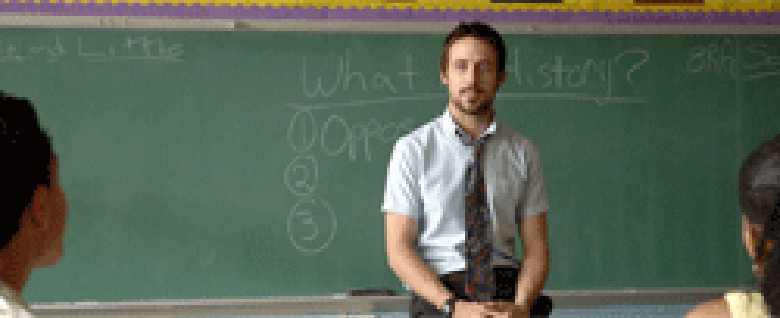
Another Sundance success now making the rounds of international film festivals, Ryan Fleck’s debut feature Half Nelson gives the well-worn inspirational high school drama genre a much needed shot in the arm (pun intended). We’re all familiar with the trappings of the genre: a rundown inner city school, a classroom full of disaffected multiethnic students, a teacher determined to buck the system. The difference here is that the teacher in question, Ryan Gosling’s Daniel Dunne, is worse off than his charges: a disillusioned, world weary cocaine addict.
Daniel teaches history, focussing on the civil rights movement, a hot button topic for his class of mostly black students. He tries to involve them in the key issues, using the political struggles of the ’60s to reflect both the kids’ own lives, the world they inhabit, and the ongoing struggle of opposing forces throughout history. But his own world is falling apart: lonely and snow-blind, the only part of his existence which holds any meaning is the time he spends in the classroom. And as he sinks deeper into apathy and addiction, his teaching becomes less focussed and more erratic.
The possibility of salvation arrives in the form of 13-year-old Drey, the intense, angry daughter of estranged parents who catches Daniel smoking crack in the girls’ locker room after a basketball game. They are bound by this secret, and Daniel begins to feel a responsibility towards the girl, another potential victim of the class and race biased American school system. Further complications arise when local drug dealer Frank, an old friend of Drey’s incarcerated brother, offers the girl a chance to make some easy money by delivering packages to his local clients. Acknowledging the irony inherent in his attempt to act as a role model, Daniel tries to steer Drey away from Frank and his crew, risking his own safety in the process.
As screenwriters, Fleck and Anna Boden seem determined to avoid any hint of judgement or recrimination: these characters exist in a grey world, where Frank can be shown to genuinely care for Drey even while he exploits her, and where Daniel’s good deeds are continually undermined by his own selfishness and confusion. There are no easy answers, this isn’t Dangerous Minds or Coach Carter: by the end of the film no one is necessarily better off, just better educated. It’s the journey that counts here, the acceptance of individual frailty and the potential for misjudgement.
Fleck and Boden expanded the film from their award winning short Gowanus, Brooklyn, and it shows: the characters feel rounded and well-explored while the plot is loose and rambling, initially centred around Daniel but gradually shifting emphasis to include Drey and her relationships with her mother and brother, and with Frank. Convincingly portrayed by first-timer Shareeka Epps, Drey is preternaturally mature but still essentially a child, looking for a father figure and torn between the dangerous but self assured Frank and the damaged, well meaning Daniel. Gosling excels as Dunne, effortlessly charming in the classroom or on the court, broken and insular anywhere else. The actor’s youth helps us to sympathise with the character—his scraggy beard feels like a thin mask of adulthood, barely hiding the boy beneath. As Frank, Anthony Mackie is a commanding presence, a family man and a thug, a street dealer with delusions of grandeur. The inevitable conflict between these two characters promises insults and bloodshed, but the scene ends with surprising warmth, and nothing decided.
This open-ended resistance to conclusion largely works in the film’s favour, but it does leave the viewer somewhat underwhelmed by the end. Fleck and Boden should be commended for their unwillingness to take sides, but it’s hard to get emotionally involved in a film when the characters are so determinedly two sided, each good deed balanced by a knowing, selfish mistake. Even Drey, the presumed heart of the film, is undermined by an inability to express herself, keeping her at a distance from the audience. Half Nelson is enjoyable and superbly written, never less than entertaining and occasionally very powerful. But it’s let down by a pervading sense of uncertainty, the filmmakers perhaps lacking the courage of their very worthy convictions.
We don’t do comments anymore, but you may contact us here or find us on Twitter or Facebook.