


Reviews
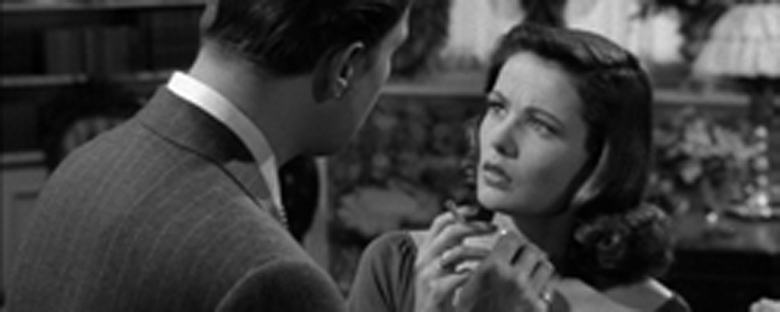
How many films have you seen that dare to begin the story with the main character already dead? Such is the case with this Otto Preminger film noir classic, a story that kicks off with the stolid Detective McPherson poking around the apartment of acerbic columnist, and erstwhile lover of the dead girl, Waldo Lydecker in search of clues to explain why young Laura Hunt stopped a buckshot-filled shotgun blast with her face.
As the story develops, and we follow McPherson on his investigative rounds, we learn that Laura had lovers in addition to the pompous Lydecker. In fact, she’d only days before accepted the marriage proposal of one Shelby Carpenter, a fawning oaf of a man who has spent his life trying to wheedle his way into high society. Might Lydecker have done away with his beloved to put an end to her infidelities? Or might Carpenter have done the deed, suspicious of Laura remaining true to Waldo? Further complicating matters is Shelby’s would-be wooer, Ann Treadwell, a woman who certainly doesn’t mind that the alluring Laura is now out of the running for Carpenter’s affections.
Filled with scads of unexpected plot twist and revelations, Laura is a blueprint of how to film a satisfying mystery. Although we are treated to a constant flow of new clues, they rarely serve to confuse or bewilder, rather working to draw us deeper into the tale, and compelling us to hazard guess after guess and jump to conclusions as to the identity and motive of the killer. Although the admirable direction of Preminger is certainly integral to our ability to enjoy the film and follow the plot, we must make note of the deft screenplay penned by Jay Dratler, Samuel Hoffenstein, and Betty Reinhardt (adapted from the novel by Vera Caspary) that brings each character vividly to life, and engages us from the first scene.
Witness the unctuous Waldo Lydecker nimbly characterized with lines such as, “I should be sincerely sorry to see my neighbor’s children devoured by wolves,” and, “In my case, self-absorption is completely justified; I’ve never discovered any other subject quite so worthy of my attention.” Or mull over the suitably gritty words of the hard-boiled Detective McPherson, including, “When a dame gets killed, she doesn’t worry about how she looks,” and, “Murder victims have no claim to privacy.” Within moments of meeting each new player in this drama, we have a clear sense of his or her personality, and we eagerly hypothesize how each intriguing piece fits into the whole.
Enhancing and embodying these astute words is a cast that is simply top drawer: Dana Andrews as the unflappable McPherson injects his strait-laced character with a subtle charm; Clifton Webb gives us a Waldo Lydecker that is at once a literary genius and a creepy conniver; With Shelby Carpenter, a young Vincent Price shows that he is just as comfortable playing a bumbling dolt as he is donning the mantle of devious villain; and of course, Gene Tierney’s Laura, depicted through flashback, is at once striking and confidently intelligent—without question a girl everyone could fall in love with, as indeed everyone does. The ability of each actor to instill his or her respective character with an endearing, robust personality draws us into the story and keeps us persistently unsure of what to believe, who to trust, and where to place our allegiances.
We don’t do comments anymore, but you may contact us here or find us on Twitter or Facebook.