


Reviews
Kelly Reichardt
USA, 2010
Credits
Review by Michael Nordine
Posted on 07 April 2011
Source Oscilloscope Laboratories 35mm Print
…and the cold crept down and the dark came early and the scavengers passing down the steep canyons with their torches trod silky holes in the drifted ash that closed behind them silently as eyes. Out on the roads the pilgrims sank down and fell over and died and the bleak and shrouded earth went trundling past the sun and returned again as trackless and as unremarked as the path of any nameless sisterworld in the ancient dark beyond.
The above passage is taken from Cormac McCarthy’s The Road, a work whose relevance to the subject of this review is not insignificant. Like that book, Kelly Reichardt’s Meek’s Cutoff charts the wandering of a small group of characters through unforgiving country on a quest whose end goal is mere survival. But where McCarthy’s story is based on speculation, Reichardt roots hers in historical accounts of a wayward caravan in 1845 Oregon. A stark aesthetic as dreamlike as it is minimalist situates Meek’s Cutoff somewhere in between McCarthy’s novel and the westerns of yore, but Reichardt puts such an unequivocal spin on this well-trod territory as to make it feel heretofore uncharted and of her own reckoning.
As in her previous films, Reichardt shows an affinity for those who’ve lost their way: She depicts not only the state of being lost but the moments of doubt therein. Unlike its predecessors, however, Meek’s Cutoff is not an of-the-moment, politicized offering; it transposes the soft-spoken tone of Reichardt’s more humble outings onto a vaster scale and takes place in a time when mountains are yet to be named. It functions in much the same way as, for instance, Wendy and Lucy, but its implications are greater. Characters speak only when they have something of vital importance to say; what warrants verbal expression tends to be expressed via hushed whispers so as not to disturb whatever may be lurking in the outer dark.
Not long into the film, the pilgrims happen upon a lone Native American (known simply as “the Indian”) who may or may not be leading his captors into an ambush. His presence creates palpable tension among the increasingly dehydrated and distraught band, several members of whom wish to dispense with him. In a way he’s a godsend, however, for the only thing keeping the caravan from turning on one another may well be the creation of a shared enemy, an other on whom they may project their fear and blame. In becoming their guide to either salvation or doom - water or blood, as Meek puts it - he brings to mind both Gollum in The Lord of the Rings and the Aborigine in Walkabout. This isn’t the only parallel between the two films: Both explore the limits of communication. This manifests itself most obviously in the language barrier between the Indian and the pilgrims but also between the pilgrims themselves, who hardly speak to or understand one another any better than they do their reluctant guide. That they travel together is merely practical, almost coincidental; shared experiences between them are almost nonexistent.
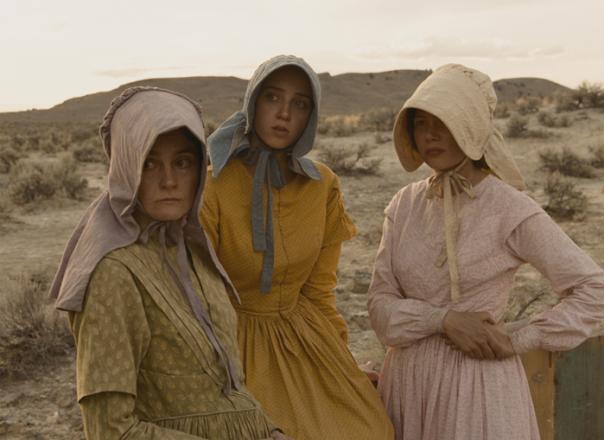
Reichardt has always been economical in her approach, a technique that’s surprisingly suited to the ambitious scope of this film. Her imagistic conveyance of isolation (both in location and of the mind) is so haunting, so purgatorial, as to take on the air of a parable for the entire human condition. In being scant on particulars, Reichardt intends not to be purposefully vague but rather to make her tale universally applicable. When the starkness of boxed-in shots of small figures traversing an uninviting landscape is considered along with similar facets of the film - the three women’s colorful dresses, the hues of which are intensified by cinematographer Chris Blauvelt’s otherwise monochrome color palette to the point of appearing altogether unreal - a uniformity emerges that underlines this predilection.
The Meek of the film’s title is an enigmatic mountain man complete with beard, pistol, and such sage (if cryptic) sayings as “We’re all just playing our parts now. This was written long before we got here.” Through Meek, Reichardt’s tendency to suggest meaning without spelling it out takes on human form. Of dubious skill and intention, he embodies the epistemological uncertainty with which Reichardt is so fascinated; whether he’s anymore trustworthy than the Indian is a matter of guesswork.
A look at Meek’s Cutoff’s beginning may may be the key to unlocking its wholly ambiguous ending. In the opening scene, the central characters are seen carefully fording a river. They wade across the gentle water, protecting what few possessions they’ve brought with them from getting wet by holding them above their heads. The other side of the river holds little promise - in fact their troubles only worsen once they’ve crossed - but still they trudge onward. To stand still would be to face certain death and, in making that short journey across the water, they come a few steps closer to to their destination. Whether that be water or blood is unknown, but still they go on.
We don’t do comments anymore, but you may contact us here or find us on Twitter or Facebook.