



Reviews
Michael Tolkin
USA, 1991
Credits
Review by Rumsey Taylor
Posted on 19 October 2005
Source New Line DVD
Related articles
Features: 31 Days of Horror
With little haste The Rapture employs two liberally populated sex scenes in its opening third. Each is either motivated or attended by Sharon, a disillusioned Los Angeles telephone operator by day and uninhibited swinger by night. In the first commensurate encounter, she and a partner eye another couple in a low-key bar. The targeted male asks, “What if things go out of control?” “What’s control got to do with it?” she retorts, her eyes narrowing behind a sheet of cigarette smoke.
These scenes merit the film’s eligibility for inclusion in USA Up All Night’s programming (it was conspicuously found in the “Night Owl” section of my local video store). It is soft core, emotionless sex; this will lend some definition to the title, at least to the viewer who hasn’t read the film’s description on the back of the video box. This practice becomes increasingly unfulfilling for Sharon, and in her spiritual evolution, The Rapture becomes something else entirely—an hour in, Sharon’s empty, insatiable lust gives way to her vivid premonitions of the apocalypse.
The sex is not designed to mis-market the film, although, surely, it must have garnered viewings with this pretense of pornography. Sharon’s story is one of redemption, and the jarring power of The Rapture is in manifesting the extent of her transformation from a disaffected temptress to a mother driven by God. There is a scene of her at her day job (repeated throughout the film’s first half), at a desk responding to calls and redirecting them. She does this, initially, with disinterested nonchalance. In a later instance, she is noticeably more enthused, and asks her listeners if they know God. She does this with a genuine smile, and her eyes no longer distil the necessity for a distraction.
Sharon’s immediate faith is exposed ambiguously, her metamorphosis given both little defense and support. This ambiguity engages the viewer’s own stance on the topic of faith and the afterlife. Sharon is a ludicrous case to some, and a deeply sympathetic one to others; hope becomes her defining characteristic, and it is either her blind flaw or her paramount strength. Criticism of Sharon’s character excepted, even more disenchanted viewers will be jarred by where her faith leads.
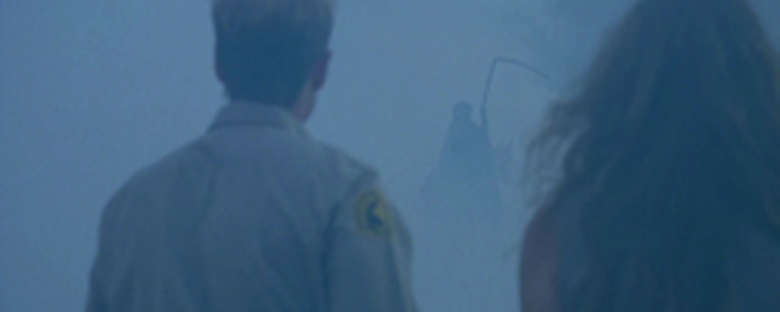
The Rapture is not ostensibly a horror film, but I found it deeply frightening, and it is so on a purely conceptual level. There are visceral frights — images of a grim reaper chasing Sharon’s car, or the powerful trumpets that signal the beginning of the rapture — but these intend to verify Sharon’s premonition. And this is the film’s most terrifying aspect, that her paranoia — her fear for the entirety of mankind — is correct.
This, do know, is but one of the film’s revelations, and analogizes the film with other depictions of verified paranoia (They Live, The Matrix, Terminator), but unlike these thematic similarities, religion is The Rapture’s blatant agent of faith (it is much more ambiguous in the aforementioned films), which the film is designed ingeniously to question. Late in the film, in sudden and intense anguish, Sharon fires the remaining rounds in a revolver directly into the air; the gesture illustrates the film’s angered and unsatisfied interrogation. The film culminates in the word “Forever,” and ends with a tragic image of permanence, followed by a silent credits scroll.
We don’t do comments anymore, but you may contact us here or find us on Twitter or Facebook.