


Reviews
John Carpenter
USA, 1982
Credits
Review by Rumsey Taylor
Posted on 11 July 2004
Source Universal Studios DVD
Science fiction and horror films are evaluated, for the most part, for their monsters. Success in either genre is determined to a large extent by the included creature, and it must be parallel to the film’s theme (a good monster can redeem an otherwise bad movie). Given this rule, The Thing is among the most impressively hostile creatures in cinema.
No description of the creature, no matter how accurate, justly realizes it. Simply put, it is a virus; it infects a host, and is not isolated to a singular body. Once dismembered, its pieces live on. In destroying the beast is the imminent threat of increasing its number.
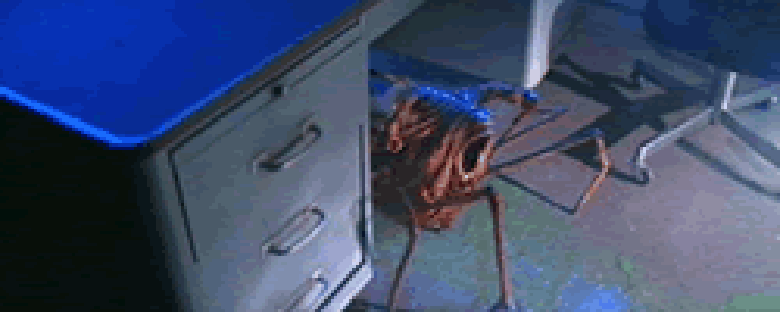
Moreover, this virus is capable of imitating any organism it has contacted (it periodically burgeons the legs of an arachnid and the corolla of a flower, often simultaneously). The film’s first victim, a dog, is taken over by the virus and sprouts parts of other organisms — but the whole, the collection of random limbs, is what distinguishes the thing. Finally, there is no effective means of killing it.
The survivors are limited to twelve at the start of the film, and they soon learn that the alien virus is capable of imitating a host with no identifiable result. Realizing this, together, the men regard each other with quiet fear. There is a killer among them, and no one is aware of who it is.
Preceding the title credits is the image of a flying saucer careening towards Earth and causing a flame trail as it enters the atmosphere. In this manner, Carpenter avoids the cliché of pre-establishing the existence of extraterrestrial life. Like other contemporary works of science fiction, The Thing relies on the collective understanding that in the universe of film the possibility of alien life is imminent; no expository background is needed.
A caption reads: Antarctica, winter 1982. A helicopter speeds low over the horizon, leading it a dog. A man leans out of the machine and shoots at it. The party (Norwegian) arrives at an American research facility, and in a moment of panic, the American scientists exit the facility. One of them is inadvertently shot in the leg, and the helicopter pilots are killed in panicked self-defense.
We know something is wrong, and repeated shots of the surviving dog find the animal in the company of the scientists. These characters are regarded unsympathetically, being that they do not share our knowledge of alien life — each is realistically skeptical of the possibility.
Two of the men visit the remains of the Norwegian camp. The place has been burned, inside is trashed equipment, a frozen corpse (the man has committed suicide), and a mysterious, thawed block of ice with absolutely no evidence of what it contained. Outside another corpse is found — this one retains much of the human form, yet is not justifiably “human.” The corpse contains an alien virus. With the scientific find of the century, the men remove the body.
An autopsy yields evidence towards the virus’ qualities (thankfully, the study does not produce a clichéd means of defense). The team’s doctor, Blair, explains what he learns, yet does not reveal crucial knowledge to their fate: he knows of a 75% possibility that one or more of the men is already contaminated, and if the virus reaches a civilized area the odds are vastly against their success. With this knowledge, Blair disables their helicopter and radio equipment. When the team locates him, he is ranting, clutching an ax, and prepared to strike the body attached to the next finger lain on him.
This action is crucial, as it illustrates how the mere threat of this creature functions to oppose the men against each other. Because they cannot distinguish the enemy, they engage in nihilistic distrust; and because there is no way to determine the killer, their anger escalates. The Thing is remembered for its effects and horror, perhaps; its drama is one of its most prominent — though disregarded — elements. In a desperate attempt to restore structure, MacReady (Carpenter regular Kurt Russell) gets a flamethrower and places a bundle of dynamite in front of its poised barrel, controversially earning the remaining men’s attention.
It becomes clear, by this point, that self-destruction is the only choice ensuring the fate of humanity. The threat, here, is collectively relevant, and in realizing this the men see the dwindling possibility that they will survive.
What complicates the protagonists’ strife is that the beast, though inhuman, is vulnerable to the same elements. It hides in the regulated climate of the facility, fleeing from fire and cold — like the human survivors, it is trapped between these dichotomous extremes. And, by exposing their enemy to a hostile climate, they are doing the same for themselves. Their battle is inseparably married to risk.
The Thing is a stalwart example of special effects. There has been criticism for the film’s gore; considering the design is intended to rip and bleed as human flesh, it can be justifiably viewed as a successful — rather than exploitative — element. The creature is a meld of working tissue, flesh and bone, yet does not honor the human frame. The effects superbly persuade the life of this creature. Unlike many computer-generated monsters, there is an awkward and tangible reality to The Thing’s monster — the actors are indeed interacting with a creature rather than merely looking in the right direction and responding appropriately.
The distinguishing aspect of the film is its setting. Antarctica, though slightly exotic, is overwhelmingly empty, providing neither refuge nor intercontinental communication; it is a trap. As the men near the height of their conflict, the film becomes increasingly claustrophobic.
Underlining every frame of The Thing is an anticipating dread: the characters — and the viewer — sense the potential menace of an enemy they cannot see. Tracking shots frequent empty hallways, draped in cold fluorescent lighting; it is a subjective viewpoint, not of a particular character, but of a characterization — it is the cinematic manifestation of a pure emotion. The film contains one noticeably frightening “scare chord”; more frightening are the many minutes that precede it.
We don’t do comments anymore, but you may contact us here or find us on Twitter or Facebook.