

Reviews
David Lynch
USA, 1990
Credits
Review by Leo Goldsmith
Posted on 20 April 2006
Source bootleg DVD
Related articles
Features: A Guide to Twin Peaks
Reviews: Twin Peaks: Season 1
Reviews: Twin Peaks: Season 2
Reviews: Twin Peaks: Fire Walk With Me
In a characteristically amber morning fog, two ducks swim away from each other in the small inlet of a lake. Inside a nearby house, gazing at herself in a mirror and humming absently, is Josie Packard, owner, by inheritance from her late husband, of the Packard Mill. In the next room, her sister-in-law, Catherine Martell, barely reacts as her husband Pete declares that he has “gone fishin’.” Outside, Pete notes, a “lonesome foghorn blows,” insistently and irregularly. Walking away from the house, fishing rod in hand, Pete chances to turn around. Washed up on the pebbly shore of the lake is an odd shape. Wrapped in plastic and tape is what appears to be the body of a woman, naked, her hair spilling from one end of the wrapping like smoke from the end of a cigarette.
The opening scene of Twin Peaks, culminating in the discovery of a body that we will soon learn is Laura Palmer’s, seems quite banal, relating to what might be presumed an ancillary subplot in the series about to unfold—namely, that of the byzantine machinations surrounding the Packard Mill and its ownership. But like so many portraits of everyday life in David Lynch’s work, the scene lacks a sense of familiarity: Jack Nance’s idiosyncratic reading of Pete’s character, Catherine’s impossibly cool demeanor, and, above all, the seemingly incidental introduction of Josie, mysterious and almost stuporous, in the first frames of the series’ pilot. These brief portraits of the fractious Packard-Martell family cluster, going about its morning routine, suggest an uncertainty, a dis-ease, symbolized by the diverging ducks and by the image of Josie and Catherine in the next scene, clad in contrasting outfits, observing the police investigation of Laura’s body from their doorstep.
These opening scenes portend the hidden conflicts, doublings and divisions, both inner and outer, but they also suggest the importance in the series of distant or buried signals and communications. Like the lonesome foghorn, there are many signs to be interpreted and heeded, and their meaning and provenance is not always clear. When Pete calls Sheriff Harry S. Truman on the telephone — telephony being a particularly significant motif in Twin Peaks and in Lynch generally — Lucy’s emphasis on the precise location of the phone to which she has transferred the call is not only the mark of a ditzy, if diligent, receptionist, but also an early indication of the subtle importance and occasional difficulty of communicating.
Later, we see a failure of communication with Sarah Palmer insistently calling her daughter down for breakfast before school. Failing to locate Laura in her bedroom, Sarah calls the home of Laura’s boyfriend, Bobby Briggs, who is also nowhere to be found, and then her husband, Leland, at the Great Northern Hotel. Leland attempts to calm his wife, but when he sees that Sheriff Truman has come looking for him, he understands immediately this visit’s import. At the other end of the phone line, and almost telepathically, Sarah Palmer also understands.
The news of Laura’s death — its occurrence, if not its circumstances or meaning — is one piece of information that travels quickly. Even before Principal Wolchek can issue his tearful announcement on the high school’s public address system, rumor and presumption have insinuated themselves throughout the school. A girl runs wailing through a courtyard, and Donna Hayward, Laura’s best friend, notices her friend’s school desk is empty. Exchanging quizzical glances with the doe-eyed, leather-clad James Hurley, the two secret friends understand in a moment that something terrible has happened, something that perhaps, in some oblique way, they had anticipated.
The foggy, amber air of sorrow that permeates Twin Peaks (both the town and the series) is given its most purely, expertly melodramatic iteration in the series’ first hour, with a boldness and knowing sense of passion that is later parodied in the series’ fictional soap opera, Invitation to Love. But the darkly enigmatic aura, the mysteriously sexual nature of Laura’s murder, and the almost perverse invocation of tragedy sustain a general sense of shock and of an intense, elegiac longing for the beloved deceased. It is also crucial to note the significance of Angelo Badalamenti’s score — at once stridently operatic and patently synthetic — in establishing this mood. And with this undertone in pace, small secrets begin to reveal themselves: a locked diary and a camcorder in Laura’s bedroom, and, staggering across a railway bridge, a millworker’s daughter named Ronette Pulanski appears in torn and filthy underwear, broken bonds at her wrists, and a vacant look of terror subsiding in her eyes.
With this sudden appearance of the less missed millworker’s daughter, and with her fortuitous crossing of a state line, another line of communication from beyond is opened, this from the Federal Bureau of Investigation. Special Agent Dale Cooper arrives in Twin Peaks, already singing his ovations to Douglas firs and homemade pies to his colleague Diane on a handheld micro-cassette recorder.
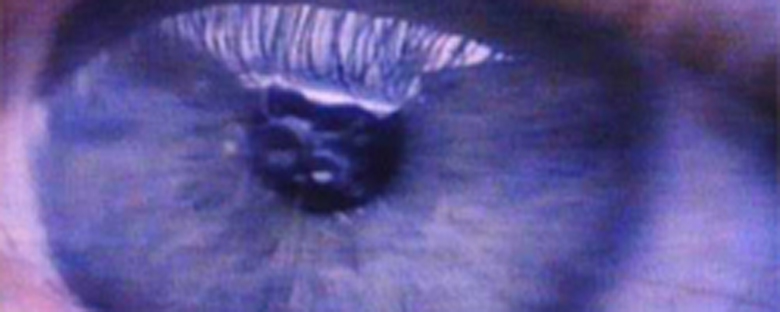
It is by now apparent that Laura Palmer’s death (and, lest we forget, Ronette Pulanski’s rape and torture) is the result of more than random and senseless violence. Ronette’s comatose whimpers of “Don’t go there” connote specifically a place of great danger, and a dissolve from Laura’s lifeless, grey, and beautiful face to an angry, windblown stand of Douglas firs implicates a more sentient evil force, embedded in the very landscape of Twin Peaks. Furthermore Cooper’s arrival, and his canny and immediate command of the investigation suggest that he himself already knows a great deal about what occurred the previous night. He knows to look for a tiny scrap of paper (here marked with a typewritten “R”) under the fingernails of Laura’s left ring finger. And his methodology, erudite and axiomatically anal-retentive, leads him to immediately dismiss the aggressive and arrogant Bobby, Truman’s prime suspect, as innocent—at least of the murder. Cooper pursues the small details of the crime diligently—the motorcycle glimpsed in the reflection of Laura’s eye on a tape in the camcorder, the person (denoted by the initial “J” in Laura’s diary) whom she was to meet the night of her murder, and even a small box of chocolate bunnies. Even Laura’s connection to Ronette, initially considered unlikely, is quickly discovered in a secret safety deposit box: an issue of Flesh World magazine, featuring Ronette on a dog-eared page. These small details reveal that Laura’s life, while brief, was full of secrets, but it is the crime scene that most intrigues Cooper. In an abandoned railcar near the woods, stained liberally with Laura’s blood, is a small mound of dirt, roped with one half of a broken-heart necklace. At the base of this mound is a scrap of newsprint with a phrase, written in blood: “FIRE WALK WITH ME.”
“These crimes occurred at night,” Cooper warns the citizens of Twin Peaks, revealing this murder’s connection with the similar death of another girl, Theresa Banks, the previous year. As night descends on Twin Peaks, a single traffic light changes to red, and the residents of the town console and conspire with one another: Norma Jennings meets Big Ed at the Roadhouse where his wife, Nadine, won’t see them; Bobby and Mike go out to exact revenge upon a certain biker; and Donna sneaks out of her house to meet James Hurley. Deep in the woods, the two meet not only to bury James’ half of the broken-heart necklace, but also to hide the love growing between them. As James tells Donna of his last meeting with Laura, in which she seemed to him a different person, we sense that there are still graver secrets yet to be revealed, secrets that will soon be unearthed, like the necklace itself in the terrifying vision that visits the grieving Sarah Palmer at the pilot’s conclusion.
We don’t do comments anymore, but you may contact us here or find us on Twitter or Facebook.