


Reviews
Wolf Rilla
UK / USA, 1960
Credits
Review by Jason W
Posted on 23 October 2005
Source Warner Bros. DVD
Related articles
Features: 31 Days of Horror
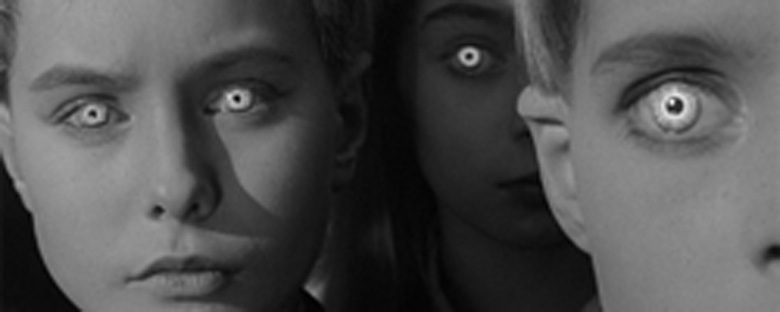
Wolf Rilla’s Village of the Damned has been read as an allegory for many things since its release more than forty years ago. Peter Biskind, in his brief analysis of the film, views the group of children with the matching blonde hair and glowing eyes as the hyperbolic realization of a conservative peer group gone wrong. Indeed, the group of children at the center of the film’s narrative all look the same, dress the same, act the same, and seem to share a collective consciousness in their decision making. Gordon Zellaby (played by George Sanders) even says at one point, “What we are dealing with here is a mass mind!” Biskind goes on to point out that once it is made clear that these children are bent on taking over not just one village but the world entire, even the solution for stopping them is a conservative one: “[Zellaby] simply blows them to smithereens with dynamite.” However, to claim the Village of the Damned children as examples of what happens when members of a society are taught to act too much alike would be erroneous. The children in the film don’t have to be taught to act as one, but come out of the womb ready to conform, if only to one another.
Another strong conservative element in the film is that of a sexual nature, and more specifically of female sexuality. By the middle of the twentieth century, the common female fear of unwanted pregnancy, as well as the fear of being abandoned by an irresponsible male after becoming pregnant, was moving to the foreground and being dealt with in a very pragmatic way in the introduction of scientific advancements in birth control. The narrative of Village of the Damned acknowledges the struggle that was taking place between religion and science over these new forms of birth control — most notably the birth control pill — in the decade leading up to the film’s release. The scientific community’s emerging ability to play God in reproducing humans through artificial insemination and test tube birth further complicated the traditional understanding of what it meant to be a childbearing female, as well as what it meant to be a sexually empowered female.
Village of the Damned opens with the entire population of Midwich, a small English village, falling asleep, only to reawaken a short time later. The adults of Midwich are forced to take a sort of afternoon nap against their own will. Upon waking, it’s revealed that every woman in Midwich capable of having a child is pregnant. Once the residents of Midwich figure out that not only have the women of the village been impregnated under mysterious circumstances, and not by their husbands, but will be giving birth to their children much sooner than normal, a mounting sense of fear begins to emerge as to what could be growing inside of these women.
In a different film, the case of an entire village falling asleep followed by the women of that village discovering they have been impregnated, could be regarded as a sort of communal Immaculate Conception. However, by 1960, the story of the Virgin Mary and the idea of a female becoming unknowingly impregnated no longer carried with it the pristine, positive ideals purported by religious teachings. The scenario presented in Village of the Damned is a frightening one, carrying with it elements of the common female fear of being raped, as well as the subsequent fear of an unwanted pregnancy from having been raped. And so, the film presents an Immaculate Conception gone wrong. The children that result from the mysterious pregnancies are terrifying to the entire population of the village, but are particularly terrifying to the mothers who birthed them, not only because the children have turned out to be so odd and frightening, but also because their uniqueness serves as a constant reminder that these women were violated while unconscious, and by whom, they do not know.
The difference is that in the case of pregnancy, the entire burden can be easily and unfairly placed upon the female, because not only does she have to carry the child through its first nine months of growth as well as birth it, but a woman is also the sole bearer of obvious, often excessive changes to her own body throughout the pregnancy. In the case of the Zellabys, an emphasis upon the fear of rape and unwanted pregnancy emerges through contrast: Anthea Zellaby is full of fear and doubt throughout her pregnancy, while her husband Gordon is calm and unconcerned, despite being equally unaware of what his wife is carrying inside of her body.
The opening sequence of Village of the Damned also explores the fear of inbreeding and its consequences, but again, the film deals with inbreeding through a series of contrasts. Inbreeding stereotypically results from isolation. The already isolated village of Midwich becomes further isolated by the boundaries drawn up by the scientists and military who are trying to figure out why everyone in Midwich has fallen asleep at the same time. The eventual scenario that unfolds, however, turns out to be the exact opposite of an incestuous situation. Not only are the impregnators from very far away, as they are probably interstellar travelers, but the children that result are also the opposite of typically inbred children. Rather than being mentally and physically compromised, these children are ultra-intelligent, developing at mental and physical rates unheard of to mankind. They are even telepathic, capable of making others do as they please, no matter how dire the consequences may be.
Gordon Zellaby is an interesting figure in all this, in that he begins the film as a logical man of science, as well as somewhat overly calm and unsympathetic to what his wife is going through during her pregnancy, as well as the emotional pain and fright that she endures after having given birth to their child. Released in 1960, Gordon’s behavior in Village of the Damned is prescient in its anticipation of the threatening realities the birth control pill – as well as test tube babies and other modern means of reproducing humans – would have upon males in the emerging decade ahead. Not only did these new types of technology disempower the male and his ability to reproduce, but it also empowered females, partially because they could enjoy sex solely for pleasure, and partially because women were more capable than ever of deciding when and if they wanted to become pregnant.
Once Gordon realizes that the child his wife is carrying is probably not his and that he has been disempowered in his role as both a husband as well as a sexual being, he becomes even more excited than when he thought that it was his own child. In fact, Gordon becomes the only person in all of Midwich to show a genuine, growing love for the children, growing even more enthused and optimistic as he witnesses the children’s development.
The figure of Gordon Zellaby is a troubling one, to say the least. Gordon replaces his wife’s role as a mother, and becomes a father-figure to the entire group of children in a way that acknowledges the fear of irresponsible males when it comes to children. These are not Gordon’s offspring, not even the child that his wife is the mother of, and yet Gordon functions as a sort of idealized, ultra-responsible male, regardless.
The role of the children in Village of the Damned is also troubling, as is the film’s presentation of what one would normally expect of a child. Even if children are typically considered “bad,” in the sense that they misbehave or act in delinquent ways, one usually gets a sense that they are still less powerful, both physically and authoritatively, than the adults around them. The children in Village of the Damned, however, are not only more developed and advanced than the adults around them, but they possess genuine control over these adults. In Midwich, it is the children who discipline the grownups. At the rate these children are growing, they will soon be able to reproduce as adults themselves.
Village of the Damned examines female angst in regards to the role of control and choice when bearing children, ironically by not giving the women in the film a choice in such matters. The children that result, then, can be seen as exaggeratedly evil in order to justify — and guiltily express — the decision to not want to bear offspring in the first place. Besides existing as the physical incarnation of a collective psychic guilt on the part of Midwich’s adults, the children remain isolated and constantly battling adults throughout the film. In this sense, these children are simply trying to survive in a time when bearing offspring is no longer a consequence, but a choice.
The ending of Village of the Damned, in which Gordon sees the only solution to stopping the children is to blow them up, and himself in the process, becomes a sort of abortion after the fact, in which scientific logic conquers God’s will (the communal immaculate conception that opens the film). That Gordon dies with the children also points to the awkward re-shuffling of gender roles that has taken place throughout the film, and Gordon’s own inability as a male to accept these changes. Having attempted to nurture the children, Gordon responds to his failings, and to his frustrations over the absence of a nurturing female presence, by reverting back to a state of primal panic, drawing (but never verbalizing) a hyperbolically macho conclusion: “If you won’t take care of these children, then I’ll take care of the situation.” Gordon’s beliefs reflect the outlook of the film as a whole, which subtly blames shifting female sexual priority for the outbreak of unwanted, unlovable children that take over Midwich, and nearly take over the world.
We don’t do comments anymore, but you may contact us here or find us on Twitter or Facebook.