


Reviews
La Rancune
Bernhard Wicki
USA / France, 1964
Credits
Review by Moira Sullivan
Posted on 11 July 2004
Source 20th Century Fox 35mm print
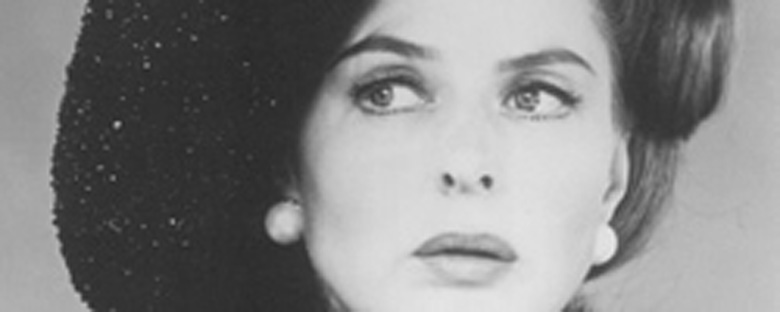
From start to finish, The Visit is commanded by the presence of Ingrid Bergman. She was scorned by Hollywood for leaving her husband for an Italian director, and is here cast in a role that allows her to address the people that exiled her. As a young woman, Bergman was given virtuous roles that endeared her to the public, which was why her exile angered them. (Ernest Hemingway was prepared to take out a full-page ad in Hollywood Reporter in her defense.) Nevertheless, she had tired of superficial roles and was willing to accept low pay for challenging parts in Rossellini’s realist cinema, as in Stromboli, the first picture he invited her to make in 1949. Bergman received a standing ovation at the Academy Awards when she returned to accept an Oscar for Murder on the Orient Express, years after leaving Hollywood. Bergman’s role in The Visit is an irony, as she plays a woman who returns to face her past.
Bergman plays Karla Zachanassian, who as a young girl was beaten by her schoolmaster. Her father was a hopeless alcoholic and her mother the subject of town gossip. At the age of seventeen, she falls in love with Serge Miller, the local shopkeeper, and eventually becomes pregnant. He denies being the father when she files a paternity suit. Later she loses the child and is forced to leave town. She moves to Trieste, and because of her disgrace is forced to survive through prostitution.
Two decades later she returns, extremely wealthy and with a desire for vengeance from the people of the mythical Pan European village. (It is claimed that here Lord Byron wrote his poetry and Brahms composed his music.) She brings a lawyer and two witnesses who confess Serge bribed them years ago to testify that Karla had slept with them, casting serious doubt on her paternity suit.
Karla claims that with this deceit her spirit died, and offers two million dollars, one for the township and one to be divided among the citizens of the village upon the execution of Serge, Karla’s one condition for payment.
It is triumphant for Karla to witness how morals can be discarded for a price. The townsfolk and elected officials that ran a seventeen-year-old girl out of town equally turn against Serge, who says he was only human, asking forgiveness and understanding. As Karla dines in her apartment over the courtyard adjacent to his shop, she watches the town transform from self-righteous indignation over killing a man in vengeance to a demonstration that everything, even human life, is a commodity that can be bought. As in Casablanca, “human life is very cheap.” Yet, she cannot take comfort in the complicity of the townsfolk.
Karla’s secretary is a young woman named Anya, who might be the same age as her dead child, and who perhaps acts as careless as she had when she was young. Karla counsels her in an effort to prevent the same mistake, bidding Anya to leave the married man she is with and offering to take her on the road after her “visit.” This is perhaps Karla’s most valuable salvation.
Austrian Bernhard Wicki directed The Visit, a writer as well as actor (Wicki played Doctor Ulmer in Paris, Texas). His film, an international co-production made in Italy at Cinettà, is embellished with well-constructed scenes, excellent camerawork, and outstanding performances, such as when Karla momentarily rekindles her love for Serge. The scene is shot at sunset on a dock with a delicate light hitting the two actors in an embrace in close-up. Karla marvels at how his hair was so black when he was young, how their whole life was ahead of them. For a moment, she loses herself in the past in a wild and passionate moment only to tragically discover Serge has grayed, recalling the life she was forced into. As she comes to her senses, there is an abrupt end to the lyrical scene.
Ingrid Bergman, at forty-nine, was at the peak of her career in this film, and is powerful and dynamic as Karla. She remarked in letters housed at the “Ingrid Bergman Archives” at Wesleyan College that her mature roles were more interesting than in her earlier (and more renowned) roles, such as in Casablanca. The choice of a property like The Visit demonstrates how well she lived out her conviction to evolve and transform as an actor.
We don’t do comments anymore, but you may contact us here or find us on Twitter or Facebook.