


Reviews
Jean-Luc Godard
France, 1967
Credits
Review by Rumsey Taylor
Posted on 11 July 2004
Source New Yorker Films VHS
Related articles
Reviews Week End by Ian
Corinne describes a lucid, explicit sexual encounter to her boyfriend, Roland, early in Jean-Luc Godard’s Week End. She is casually dressed in her underwear, her older boyfriend in a suit, and she recounts the episode with an excited, confident pride. Roland listens eagerly. As the story climaxes (it involves her affair with a married couple) it becomes abruptly grotesque. The remainder of the film will portray the irksome vanity of this pair. This episode is a reflection of their tastes and practices. The viewer is to be repelled.
It is unusual that central characters are this discriminated. In this scenario, Corrine and Roland are products of high culture, and are pompous, irresponsible, and unsophisticated. It is a tactic of manipulation that this pair occupies the narrative focus of Week End. In viewing it one is urged to condemn.
Such indictment of class and privilege is a recurrent trend in French cinema of the era. Along with its peers Playtime and The Discreet Charm of the Bourgeoisie, Week End is - at times - playful and comic. Of these peers, Week End is by far the most aggressive and violent. Granted, the film is exceptionally self-referential; any death carries the implication of its staging and fiction. More violent is Godard’s commentary, and it’s as caustic as in any that’s to be found in the era, or at the very least in Godard’s catalogue.
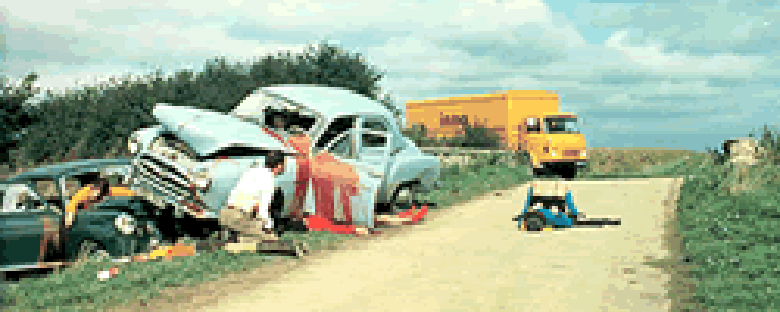
It is evident in Week End’s first scenes that Godard has outgrown his guerilla foundation (exampled seminally in Breathless) in favor of careful staging and epic mise-en-scene. This accusation is in regard to one scene: the film’s centerpiece is a tour-de-force sequence in which the camera tracks alongside the previously mentioned couple in a convertible. They drive impatiently on a rural highway burdened by traffic. The view is perpendicular to the road, prohibiting sight of the source of this great congestion. Roland swerves, passing cars in spurts of acceleration. He passes many drivers that have given up: some play chess in the middle of the road, others toss a ball from car to car. This comedy progresses. The culmination is blindsiding: the view stops, abruptly, settling on a wreck involving multiple vehicles. Bodies and pools of blood strew the road. It is a sequence (one notably evocative of Peter Greenaway’s signature cinematography) that does well to summate the film: the comedy is abundant, but it is in service to satire. There is no hint of sentimentality in this film.
Though Week End possesses an ideology, it is foremost a visceral experience. It is livid, caustic cinema. From an opening conflict in which a shot gun and tennis raquet are weapons of opposed forces to its final close-up of Corinne chewing on a piece cooked human meat, Week End constantly propagates images that convey class and taste. And in few films does privilege seem so crass and repellant.
We don’t do comments anymore, but you may contact us here or find us on Twitter or Facebook.