

Reviews

Nick’s Movie
Wim Wenders and Nicholas Ray
Germany/USA, 1980
Credits
Review by Leo Goldsmith
Posted on 09 September 2008
Source Anchor Bay Entertainment DVD
Categories The Mystic: The Films of Nicholas Ray
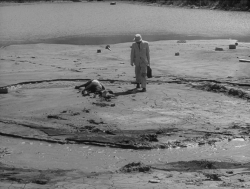
Lightning Over Water was Nicholas Ray’s last film, but it’s as much Wim’s movie as Nick’s Movie, as the film is known elsewhere. As such, it begins with a restaged version of the first scene of Wenders’ prior film, The American Friend. In that film, Dennis Hopper (as Patricia Highsmith’s Ripley), fresh off an airplane from Germany, pulls up to the exterior of a loft in New York’s SoHo, ascends the stairs and meets Nick Ray, here playing Derwatt, a painter who has faked his own death. Ripley and Derwatt have struck up an arrangement in which the painter produces new material from beyond the grave, as it were, which Ripley then auctions in Europe at inflated, posthumous prices. In Lightning Over Water, it is Wenders, fresh off the plane from California (where he is making the botched, but interesting Hammett for Francis Coppola’s Zoetrope Studios), who pulls up in the taxi and ascends the stairs to Nick Ray’s loft space. His project with Ray is something very close to Ripley and Derwatt’s: both to stage the artist’s death and to extend his life, all while exploiting the legacy of a career now worth more as ancient history.
But there are big differences between the openings of the two films, not the least of which is Ray’s physical appearance. Rather than the elderly, but still feisty (and functioning) painter we see in The American Friend, the Nicholas Ray of Lightning Over Water is first dimly perceived as a spindly form beneath bedsheets, hacking phlegm at the other end of the loft. When, after Wenders’ prologue, the camera finally locates Ray, he is being awakened by the shrill robotics of a Mickey Mouse alarm clock.”Shut up, you little sonofabitch!” howls Ray, a shock of white hair atop a skeletal frame clad in a red union suit. He lights a cigarette and runs an electric razor over his face, moaning, coughing, and yelling all the while.
The image of Ray in Lightning Over Water is shocking, sometimes even difficult to watch, but however one may criticize the film for its excesses (and many have criticized it), it nonetheless stands as some kind of document of Ray. It finds him at a particularly frail moment, to be sure, but at least in these opening scenes - rising from bed with much anguish and hacking, presiding over a screening of The Lusty Men at Vassar College in Poughkeepsie, New York, hashing out ideas for a film he wants to make (“I’m ready to start work again,” Ray soon declares.”On what?” Wenders asks. “Eh,” Ray muses.”Something really pretentious.”) - Ray is game and witty, even in his debility. If nothing else, Lightning Over Water offers rare and unsentimental moments of an elderly man, surrounded by a group of much younger, much admiring filmmakers and friends (including his wife Susan) who never seem fully sure if Ray is mentally present or doddering, numb or in great pain. (Wenders learned later that Ray, ever a self-medicator, had acquired some cocaine to help him through this first week of filming.)
But as Ray is also a cinematic icon, and as Wenders is both a friend and idolater, Nick’s Movie cannot stop short at being simply a portrait of this moribund auteur, it must also contend with his place in cinema - in life and art simultaneously - and, crudely, with Wenders’ role as his oedipal son. Exploitation, therefore, is a big issue in Lightning Over Water, not merely for the spectator trying to make sense of the film, but for the crew we see making it—especially Wenders. For although Wim’s intent - expressed in a persistent voiceover - is to sustain Ray, to honor his desire to die while making a film, to engage his still fertile imagination and passion for moviemaking, Wenders dominates the film—both superficially, with his voiceover musings, and structurally, with the array of elaborate narrative devices he brings to bear on the film.
For one thing, Lightning Over Water is not quite a documentary. Its prologue is a dramatic restaging of both The American Friend and something like a real event that occurred between Ray and Wenders, shot here in Wenders’ usual vibrant tones (deep blacks, septic greens, radiant reds). The scene is acted out (rather awkwardly, one might point out) as a fictionalization of reality, and then behind-the-scenes rehearsal video footage (shot by Ray collaborator Tom Farrell) cuts in to emphasize, if it wasn’t obvious, that this is both cinema and life. Wenders often cuts back and forth between this lush 35mm and this grainy early video, a tactic he uses to add inner conflict to the film, offering visual counterpoint to the misgivings he speaks about in his voiceover: whether the film is exploiting Ray, even killing him. As he tells Ray, in one of their candid discussions, he fears that, as a storyteller, he is”attracted to your weakness, your suffering,” and thereby”abusing you, betraying you.”
Ray’s response to this is “That won’t happen,” and yet it remains a persistent criticism of the film - by those involved in the film, like Susan Ray and the director Jon Jost (who worked for a short while with Ray and Wenders in the film’s early stages), and by various critics - that Wenders’ work betrays its hero, its sometime namesake. “Lightning Over Water is almost offensive in its manipulativeness and its naïveté that borders on callousness,” write Robert Phillip Kolker and Peter Beicken in their book on Wenders,”no matter how much Wenders attempts to mitigate his manipulations of a dying man by foregrounding the artifice of his deeds.”
It is a tough criticism to overcome, especially when, halfway through the film, Ray begins to recede a little behind Wenders’ voiceover soul-searching and to descend deeper into ill health. (Susan Ray, it should be noted, all but drops out of the film at this point, apparently the result of her disagreements with Wenders.) By the time Wenders’ then-wife, Ronee Blakly, enters the picture to act with Ray in a scene (which we are told “they” have adapted from King Lear) which features the elderly director lying in a hospital bed in a movie studio, the film seems finally to have pressed its luck, and to have exhausted its star and subject. The next scene is another long-take like the harrowing opening in which a now even gaunter Nick Ray babbles, moans, sings, and declares,”I’m finished.” He and Wenders quibble a little about who will call”cut,” and eventually Ray, sounding at once like Beckett and like a crabby, apathetic old man, blurts: “Don’t cut. Cut.”
Whatever criticisms one may have of Wenders’ role in the film, or of his intentions in making it, it must be acknowledged that Lightning Over Water honors Ray’s own wishes, if only in part. Ray wanted to die while making a movie, and the movie he describes is”about a man who wants to bring himself all together before he dies—a regaining of self-esteem for a once very highly successful man.” Perhaps what’s most disappointing about the film is that we can’t know whether Ray succeeded in this project or not—but then, when does death resolve a life with the lucidity and order of a Hollywood narrative? At worst, the film strung him along, failing to effect this important rehabilitation of Ray’s self-image; but at best, it contributed to the larger contemporary project of resuscitating the image of Ray, the brilliant auteur, even if it was too late for the Ray, the cancer-ridden body. If nothing else, the project provided Ray with the money and resources to work on a definitive cut of We Can’t Go Home Again, of which we see tantalizing snatches projected on a screen in Ray’s loft.
Nick and Wim’s movie is perhaps flawed, and although it’s distinctly a part of Wenders’ desperately uneven post-German oeuvre, it is also an appropriate sort of tribute to the director. Not a sappy, hermetic work, it is rather, like all of Ray’s best films, a daring high-wire act between improvisation and order, an adventure, and a subtle celebration of Ray’s legacy as a stylist. As such, it honors both strains of Ray’s career: the ordered, carefully staged 35mm sequences recall the precise architecture of lurid melodramas like Rebel Without a Cause and Johnny Guitar; the grainy video segments echo his later experimental years, with their maddening self-reflexivity, formal free-for-alls, and reliance on a community of students and non-professional actors. The very audacity of Wenders’ artifice - the uneasy juxtaposition of film and video, the superimposition of images and handwritten passages from Ray’s diary onto the screen - pushes the possibilities of the cinematic frame in ways similar to Ray’s later use of split-screen and optical printing. (Wenders would later explore these visual motifs more extensively in Notebooks on Clothes and Cities, but to somewhat lesser effect.) Even the helicopter shots of Ray’s funereal barge, a Chinese junk navigating New York harbor, remind us that the ethereal opening of They Live By Night marked the first time a helicopter was used in a Hollywood film. It is, therefore, difficult to accuse a director like Wenders of “taking over” from so wily, so forceful a cinematic progenitor as Nicholas Ray—Ray’s cinema is an inextricable part of Wenders’ filmmaking (and that of many of his generation), and his cinematic legacy is already consigned to immortality at the outset of the film. It is at least in this sense already Nick’s movie, regardless of who frames, shoots, and edits his physical form working, directing, howling until his natural end.
More The Mystic: The Films of Nicholas Ray
-
In A Lonely Place
1950 -

They Live By Night
1948 -

A Woman’s Secret
1949 -
Knock on Any Door
1949 -

Born to Be Bad
1950 -
On Dangerous Ground
1952 -

Macao
1952 -
The Lusty Men
1952 -

Johnny Guitar
1954 -

High Green Wall
1954 -

Rebel Without a Cause
1955 -

Bigger Than Life
1956 -

Hot Blood
1956 -

The True Story of Jesse James
1957 -

Bitter Victory
1957 -

Party Girl
1958 -

King of Kings
1961 -

55 Days at Peking
1963 -

The Janitor
1974 -

We Can’t Go Home Again
1973-1976 -

Lightning Over Water
1980
We don’t do comments anymore, but you may contact us here or find us on Twitter or Facebook.